Capurganá: Colombia's 30 Kilometers of Clear Caribbean
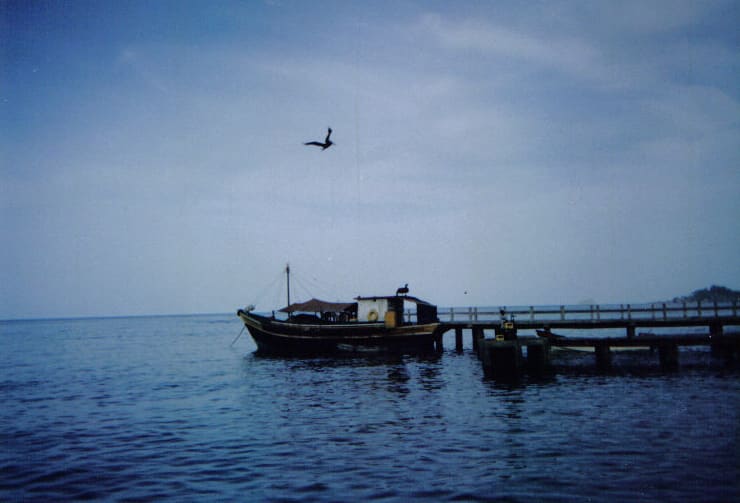
Colombia has a long Caribbean coastline, and most of it is brown. The Atrato and the Sinú pour sediment into the sea, and the water stays dark for hundreds of kilometers, all the way to the San Bernardo archipelago.
Then there is a 30-kilometer exception. It runs from Cape Tiburón on the Panama border down to the municipality of Acandí, and the water there is clear.
Capurganá sits inside that stretch. That is the whole reason a diver goes. It is also a town with no roads in, no cars, and no ATMs, which tends to be either the deal-breaker or the entire appeal.
A town with no road
Capurganá is in the Chocó department, jungle on three sides and sea on the fourth, the last town of any size before Panama. You can walk from one edge of it to the other in about five minutes.
There are no roads leading here, so land transport means horses, bicycles, motorcycle taxis, and a few tuk-tuks near the dock that mostly haul heavy freight. The Wikivoyage guide describes it as a sleepy place with a laid-back feel, long popular with Colombians and only recently showing up on the wider traveler's radar.
The name comes from the Guna people and translates as "land of chili." The Guna lived here until the early twentieth century, when they were displaced by settlers from Cartagena and moved on to the San Blas archipelago in Panama.
Tourism started with an airstrip. In the 1970s a community leader named Narcisa Navas talked her neighbors into donating land to build one, and she and the pilot Jorge Mario Uribe flew in the first tourists in a small Cessna. The first hotel, log cabins under an iraca palm roof, opened in 1975. By 1990 there were more than twenty places to stay.
Getting there
Almost everyone arrives by boat. Necoclí is the closest point with a paved road and has regular ferries. There is also a daily launch from Turbo in Antioquia that leaves at 8:00 am with room for 25 passengers, taking two to three hours depending on the sea.
From the Panama side, Puerto Obaldía is about 45 minutes by boat. Flights from Medellín run to the tiny airport, and chartered air taxis can bring you into Capurganá or nearby Acandí.
Bring cash. There are no banking facilities and no ATMs in town. If you run short, the Hostal Capurganá on the main road takes credit cards with a 6% service fee, and you can book boats and flights there; booking at the harbor with a card costs 19%.
The diving season
The best diving runs from April to November, the middle of the winter season, when the waves practically disappear. From January to March the wave action picks up and navigation gets difficult. Dive operators in town work with PADI certification to international standards, and Dive and Green quotes COP$180,000 for two dives.
| Month | Sea temperature (°C) | Wave height (m) |
|---|---|---|
| January | 28 | 1.3 |
| February | 28 | 1.5 |
| March | 28 | 1.3 |
| April | 29 | 1.0 |
| May | 30 | 1.2 |
| June | 30 | 1.1 |
| July | 30 | 1.3 |
| August | 30 | 1.3 |
| September | 30 | 0.5 |
| October | 30 | 0.5 |
| November | 30 | 1.0 |
| December | 29 | 1.2 |
The numbers line up with what locals say. September and October show the flattest water of the year at half a meter, February the roughest at 1.5. Sea temperature barely moves, sitting between 28 and 30 degrees all year, which is about as consistent as the Caribbean gets.
Turtles, frogs and beaches
Chocó is thick with species, and some of them are worth timing a trip around. Local boats run to a beach called La Playona, where leatherback and hawksbill turtles nest in March and April.
On land, the Chocó poison frogs are the draw. The dark green Dendrobates auratus is common in the area, and you will spot them without looking hard.
Of the two coral sand beaches the town had until the mid-1980s, only La Caleta remains. The sea took the sand from the Virgin of Uvita beach and left the coral cliff exposed. There is also La Miel, just across the Panama border: COP$20,000 per person for a round-trip boat, no passport needed, and the bars take pesos or dollars. You can also walk it in about 45 minutes, up a lot of stairs.
Staying and eating
Lodging spans a wide range. Camping at Hospedaje Nelly runs COP$7,000 and rooms start at COP$15,000; Los Delphines and Cabaña Darius also start around COP$15,000. At the other end, the Tacarcuna Lodge, the descendant of those original 1975 cabins, goes for COP$150,000 a night.
For food, the Posada del Gecko does pizza, Italian plates and cocktails. Inland from the airfield there is El Cielo, a hike to freshwater pools with a small restaurant at the end, COP$3,000 to enter.
One other detail worth knowing before you arrive: despite the written accent on the last syllable, locals say CapurGAná, stress on the third. The full town history is on Wikipedia if you want the longer version.
Planning it
Aim for April to November, get yourself to Necoclí or Turbo, and carry enough pesos for the whole stay. Buy a SIM at the shop on the corner of the football field with the Colombanco sign hanging outside; they will set it up and load a data plan for you.
If you make it to that 30-kilometer window of clear water, log the dives in Scubaspot and note the month, because the difference between February and October here is the whole trip. Rate the sites your operator takes you to, and if you catch the turtles at La Playona in March or April, add the photos so the next diver knows when to book.