The Blue Hole, Dahab: a 100-metre hole you walk into from shore
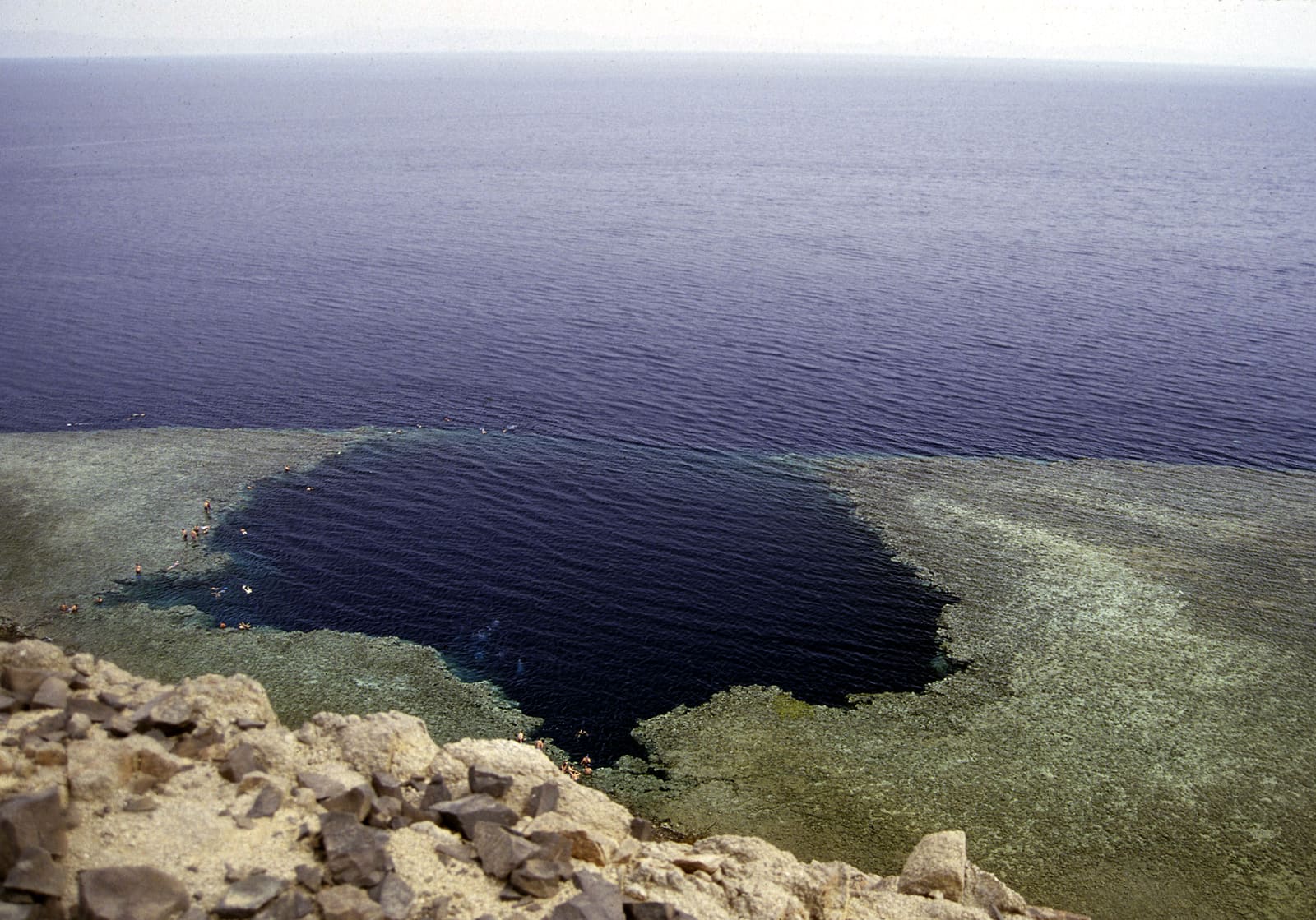
You park on a strip of gravel, walk past the cafes, and step into the Red Sea. That is it. No boat, no ladder, no long steam out. Within a few fin kicks the coral rim drops away beneath you and you are floating over a shaft of water just over 100 m deep.
The Blue Hole sits on the southeast Sinai coast, a few kilometres north of Dahab, on the Gulf of Aqaba. That combination of real depth and shore access is why it has pulled divers and freedivers here for decades.
The hole itself is ringed by coral and busy with reef fish, and there is no current to fight. Plenty of people come for the geology and then stay for the fish life on the rim.
How the site is put together
Three features give the Blue Hole its shape, and knowing the names helps when you listen to people talking it over afterwards.
- The saddle: the shallow opening connecting the hole to the open sea, around 6 m deep.
- The Arch: a 26 m long tunnel through the reef wall, its ceiling at 55 m.
- The outer wall: on the seaward side the floor drops steeply to over 1,000 m.
The Arch is the feature everyone has heard of. Its bottom falls away toward the seaward side to around 120 m, and the water is clear enough that the tunnel looks far shorter than its measured 26 m. Divers who have swum it report thinking it was under 10 m long.
There is a second way in. The Bells entry is from the shore a little further along the coast, and at 26 m at the bottom of the Bells there is a mini arch, which is not the Arch and gets confused with it constantly. From there the dive runs along the wall and finishes by crossing the Blue Hole saddle at 7 m.
A site with a long memory
The Bedouin people who lived along this coast historically avoided the hole. Modern diving arrived later: in 1968, during the Israeli occupation of the Sinai, a group of Israeli divers led by Alex Shell made the first scuba dive here and spotted the underwater arch. The peninsula returned to Egypt in 1979, and by 1982 the Blue Hole was being dived almost daily.
It is also the dive site with the most notorious reputation in the world. Tarek Omar, a technical diver from Dahab who has recovered bodies from the hole, estimated in 2012 that more than 130 divers had died there in the previous fifteen years; another estimate puts the figure as high as 200. The Egyptian Chamber for Diving and Watersports now stations a policeman at the site.
The best known of those deaths is that of Yuri Lipski, a 22-year-old Russian-Israeli instructor who died in April 2000 at 115 m, with a running camera. Omar, who had warned him against the dive, recovered his body and the camera the following day. If you want the fuller account, the Wikipedia entry) covers it, as do documentaries including Monty Halls' Dive Mysteries: The Curse of the Blue Hole and The Deepest Breath.
What the water does through the year
This stretch of the Gulf of Aqaba is warm and calm by most standards. Sea temperature bottoms out around 21°C in March and peaks near 29°C in August, with modelled wave heights sitting between 0.3 and 0.8 m all year.
| Month | Sea temperature (°C) | Wave height (m) |
|---|---|---|
| January | 23 | 0.5 |
| February | 22 | 0.6 |
| March | 21 | 0.6 |
| April | 23 | 0.6 |
| May | 24 | 0.8 |
| June | 26 | 0.7 |
| July | 27 | 0.6 |
| August | 29 | 0.5 |
| September | 28 | 0.7 |
| October | 26 | 0.7 |
| November | 26 | 0.3 |
| December | 24 | 0.6 |
The flattest month in the model is November, at 0.3 m, with water still around 26°C after the summer. March is the coolest at roughly 21°C. Figures come from Open-Meteo marine data for 2026, so treat them as a shape for the year rather than a forecast.
Marine life and the rim
The hole and the reef around it carry an abundance of coral and reef fish. That is the honest summary. The drama here is architectural, and the fish life is the texture you swim through on the way to it, thickest along the saddle and the top of the wall where the light is.
Freedivers love the place for the same reason scuba divers do: depth directly off the beach, and no current moving you around while you work. On a busy morning you will share the water with both.
Planning a trip
Base yourself in Dahab, in Egypt's South Sinai Governorate, and the Blue Hole is a short run up the coast at roughly 28.572 N, 34.537 E. Local dive centres run the Bells to Blue Hole route as the standard way to see the wall. Pick a cooler month if you prefer quieter water, or August if you want the warmest sea of the year.
When you have swum the saddle and come up over that rim, log it in Scubaspot with the depth you actually hit on the wall, rate the site, and drop in a photo of the hole from the surface so the next diver knows what that blue disc really looks like. Start at scubaspot.co.