Diving in Egypt: The Red Sea, Coast by Coast
Local divemasters in the Red Sea pull long faces when visibility drops below 20 meters. To most visiting divers, 20 meters already feels like an infinity of blue.
That clarity is not luck. The Red Sea is bordered by desert, with almost no industry, no agriculture and no rivers feeding silt into it. Nothing clouds the water the way it does in cooler seas.
Add one enormous coral reef running parallel to the entire coast, a set of famous wrecks, and cheap internal flights that let you pair a week of diving with Cairo or Luxor, and you can see why Egypt stays busy year-round. Europeans in particular pile in over winter, when the desert is shirt-sleeve weather by day.
What the water is like
Tides barely matter here. The sea see-saws around a midpoint at Jeddah, which has no tide at all, so the far ends near Hurghada and Sinai see at most a meter of range. Mostly it just tells you which way a drift will run.
Wind does more. When it blows lengthwise along the sea it heaps water at one end until it escapes back, and it turns the surface choppy, which means the boat lurches around while you are kitting up.
Summer days in the desert are blisteringly hot and the nights stay warm; a 3 mm suit or a skin is plenty, mostly to keep coral from scuffing you. Winter is a different story, with cold nights and the shamal blowing down from the north, and a 5-7 mm full-length suit with a hood earns its keep.
One quirk worth knowing: the Red Sea is more saline than the open ocean, so start with 2 kilos more lead than usual.
Sinai
Sharm el-Sheikh is the developed end of the country, with direct flights from Europe, hotels in every bracket and more dive operators than you can count. Most visitors do not need a visa for this beach strip, though they do for the rest of Egypt. The diving sits a few miles offshore, which means boats.
Ras Muhammad, the national marine park 12 km south of town, is the big draw. There is a park fee, and there is a genuinely staggering census behind the scenery: more than 220 species of coral, over 1,000 species of fish, 40 kinds of starfish, 25 sea urchins, 100-plus molluscs and 150 crustaceans. Yolanda Reef and Shark Reef lie off the southernmost promontory; green and hawksbill turtles turn up regularly.
West of Sharm, in the Gulf of Suez, is the Thistlegorm. She was sunk by a German air raid in October 1941, loaded with RAF kit for Egypt, and her holds still hold the trucks and motorbikes that made her famous. Her deepest parts lie at 30 m. So many divers and mooring boats visit that she is coming apart faster than she otherwise would.
To the east, the Strait of Tiran guards the entrance to the Gulf of Aqaba, with small islands and reefs that have claimed ships of their own. Jackson Reef and Thomas Reef are the names you will hear most.
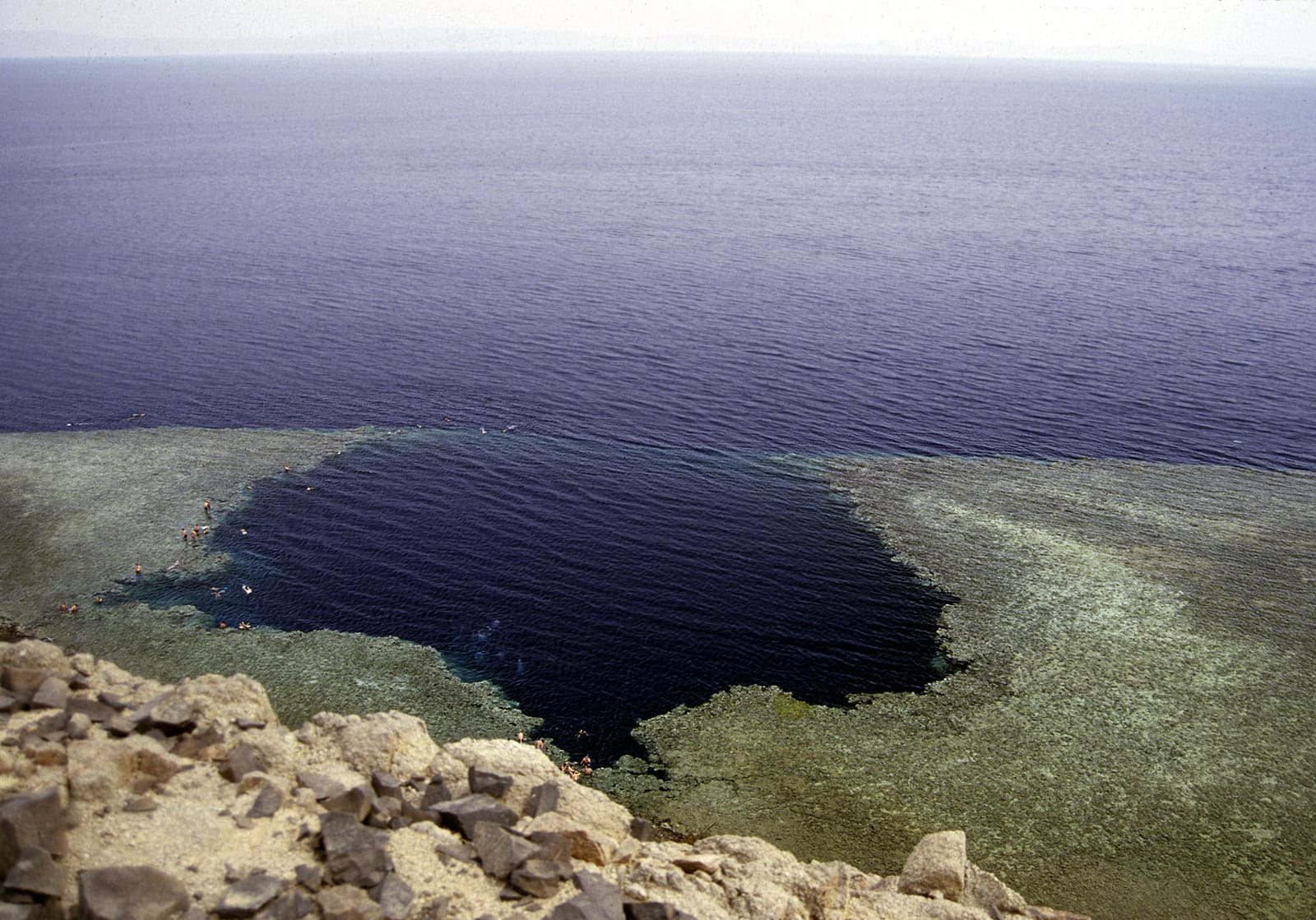
Then there is Dahab, a small mellow town where you wade in from the beach instead of boarding a boat. The Blue Hole is the landmark: divers cross it watching sunlight glimmer up through the tunnel far below, then exit over a shallow lip into the better scenery outside. Dahab is also famous for doing nothing at all, just watching the colors shift over the sea and the mountains.
North of there, Nuweiba is a real port town with little tourist infrastructure, mostly budget beach camps along the highway, and shore diving. Taba Heights and Taba have shore diving too, plus a duty-free casino strip by the Israeli border that is more quaint than raucous.
The African coast
Hurghada is the best-developed resort on this side, with flights from Europe and Cairo and a long list of operators. El Gouna, 20 km north, works as its satellite. Reefs north of Giftun Island are under an hour away: Abu Galawa, Abu Nugar, Um Gammar, El Fanadir, with Sha'ab el Erg a bit further.
The wreck hunters head for Sha'b Abu Nuhas, the reef northwest of Shadwan Island. Four ships are dived there, and they make an unusually tidy set.
- SS Carnatic, a steam clipper lost in 1869 en route to India, now on her port side in two sections, richly overgrown, maximum depth 28 m.
- Kimon M, a freighter that went down in 1978 with lentils for India; her bows sit in 10 m as a jumble, her intact stern at 25-30 m.
- Chrisoula K, lost in 1981 with a cargo of tiles for Jeddah that was never salvaged, sitting in 25-28 m with the forward section upright.
- Giannis D, lost in 1983 with timber for Jeddah and Yemen, in three pieces at 10-25 m, part-buried in sand and lying at a rakish angle.
Carnatic's copper and gold cargo gave the reef its name, which in Arabic means father of copper. Further north lies the Rosalie Moller, carrying coal to Alexandria when an air raid caught her in 1941, weeks after the Thistlegorm. She sits upright in 40-45 m.
Safaga, 53 km south of Hurghada, is an industrial phosphate port with a 15 km hotel strip along Soma Bay. Its reefs are a short ride out: Ras Abu Soma, the Tobia group, the Gamul sites, Abu Kafan and the walls of Panorama Reef.
Nearby lies the Salem Express, the pilgrim ferry that struck the reef in 1991 in Egypt's worst maritime disaster. The official toll was 470, but divers recovered some 850 bodies before the operation was abandoned, and an unknown number remain aboard. She lies on her starboard side in 32 m. Think carefully about whether you want to dive there.
El Quseir has been a port for 5,000 years, which tells you something about how close the Nile swings to this coast. Its standout site is Elphinstone, a 700 m reef wall 12 km offshore dropping to 40 m, and one of the likelier places in Egypt to meet something big.
Farther out, 67 km east, the Brothers islets carry a lighthouse that failed to save the Numidia in 1901 or the Aida in 1957. Oceanic whitetips and hammerheads cruise there, and only liveaboards make the trip.
Marsa Alam has its own international airport, 60 km north by Port Ghalib. Spinner dolphins, dugongs and hammerheads are all on the cards here. Samadai Reef, 11 km southeast, is a 1.4 km horseshoe around a 6-7 m lagoon that suits snorkelers better than divers, while Sataya out in the Fury Shoals gets fewer visitors and more sharks. Daedalus Reef, 90 km out with a lighthouse on an artificial islet, is liveaboard country.
Keep going and the crowds vanish. Berenice, 110 km south of Marsa Alam near Ras Banas, is barely developed, and most divers arrive by liveaboard bound for St John, Zabargad, Daedalus and Rocky Island. Every barren lump out here is rocky except Rocky Island, which is sandy. Make of that what you will.
What you'll actually see
The ecology is Tropical Indo-Pacific. Clouds of anthias hang over the reef, tetras sparkle in the rocks, and pufferfish, scorpionfish and moray eels, some of them gigantic, show up on most dives. Turtles and sea horses favor the sea-grass meadows. Tarpon and tuna pass through, and dolphins sometimes ride along with the boat.
The reefs here came through the 2014-16 global bleaching event with only light damage, and Red Sea corals look relatively tolerant of warming water. Worth knowing: reef close to a resort may already have been stripped by coral-hunters, which is part of why the boats run a few miles out.
Planning notes
Both coasts have airports with European connections, and internal flights and long-distance taxis are cheap enough that a dive week and a run at the antiquities fit into the same trip. The chief resorts double as liveaboard bases for the reefs and wrecks beyond day-boat range, as the Wikivoyage guide lays out.
There is diving off Alexandria on the Mediterranean, where real archaeology is coming to light, but it is colder and thinner on scenery. And no, nobody dives the Nile or Lake Nasser: crocodiles.
Going? Log the Thistlegorm with a photo of the motorbikes in her holds, note the depth you found on Elphinstone's wall, and rate Abu Nuhas wreck by wreck so the next diver knows which of the four to spend their air on. Start your Egypt trip log at Scubaspot and share the feed with whoever you are dragging along.