Diving in Guam: two wars, one harbor floor
There are not many places where you can put a hand on a World War I wreck and a World War II wreck on the same dive. Guam has one, in Apra Harbor.
The 290-foot SMS Cormoran lies on her starboard side in 120 feet of water, directly beside the Tokai Maru, which went down in 1943. Divers reach the Cormoran by following the Tokai's midsection hull over the side until the German ship appears at 80 feet.
That alone is worth the flight. But Guam's diving is broader than its wrecks: reef walls inside a sheltered harbor, a vertical tunnel through a submerged cliff, coral mounds offshore, and a sinkhole with a tourist observatory sitting in it. The island has seen comparatively little tourist pressure, and it shows underwater.
Apra Harbor and the wrecks
Most of the famous metal is in or near Apra Harbor. The Tokai Maru is the big one, over 440 feet long, resting in 120 feet with an 85-degree list to port. Her shallowest point is the upper forward bridge at 40 feet.
Inside her, the cargo holds still hold truck frames, beds and scrap steel. The engine room is huge, with both engines, catwalks and panels intact. A torpedo hole gapes in the port number three cargo hold. In the after-deck house, at least four unexploded depth charges are plainly visible from the top of the structure.
West of her lies the Japanese freighter Kitsugawa Maru. Torpedoed by the submarine USS Seahorse, she was towed into the harbor for repairs and then hit by bombs and rocket fire from US aircraft. Her engine room exploded and tore the ship in two. She sits upright on her keel at an average depth of 140 feet.
Then there is the American Tanker, which is not a tanker at all. It is a concrete barge over 300 feet long, loaded with war supplies in Honolulu in late 1944 and towed to Guam by the USS Bannock and Arikara.
The USS Gear put the barges in position on the Calahan bank and sank them to form a breakwater at the harbor mouth. The pilothouse sits at 40 feet, the main deck at 60, and she lists to starboard.
Walls, holes and reefs
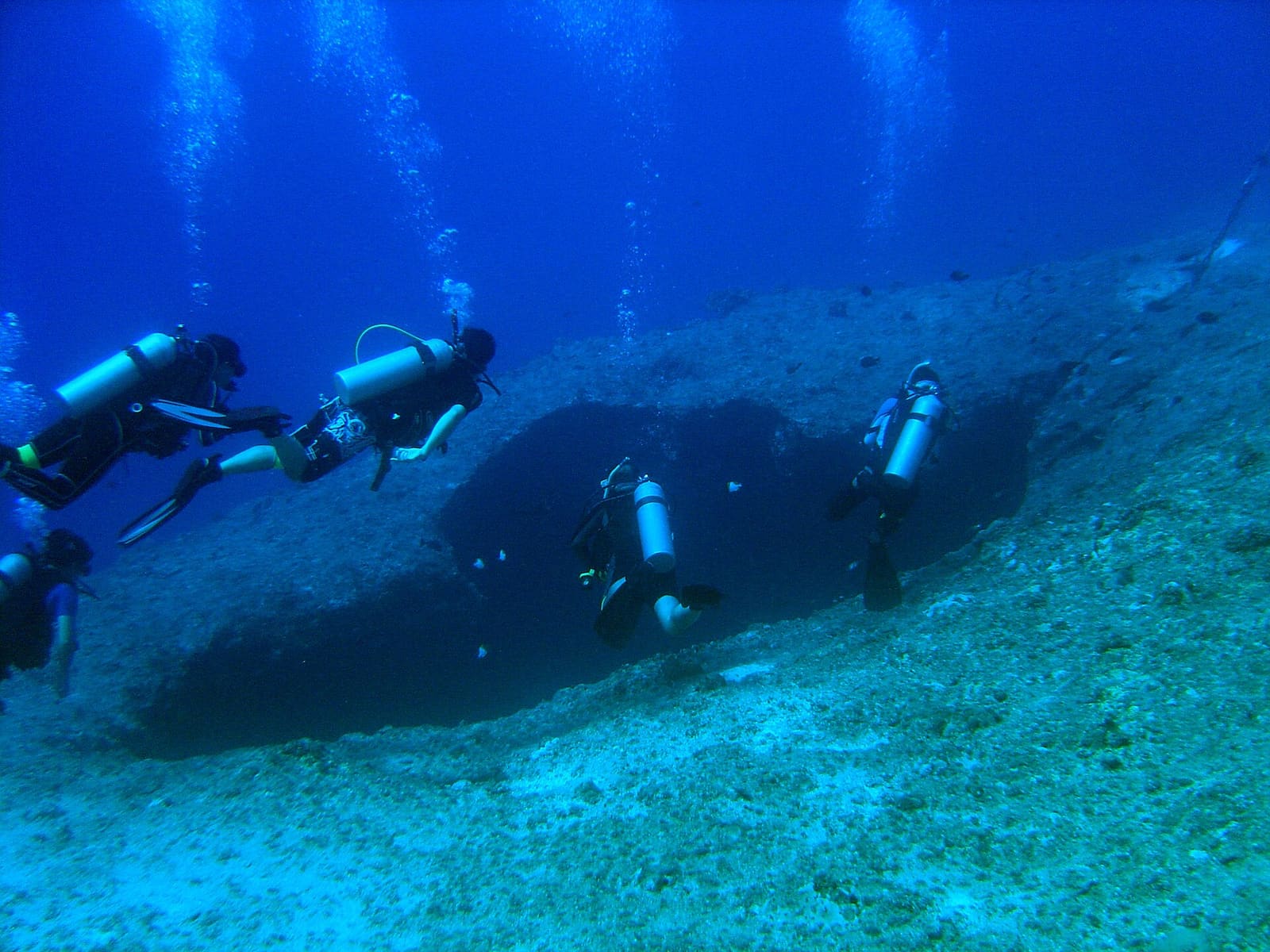
The Blue Hole is within 30 yards of shore, except the shore is a towering jagged cliff on a military base, so boats do the work. It is a wide tunnel through a submerged wall, roughly as broad as a passenger van, starting around 40 feet and dropping to about 110 feet depending on the tides.
There is a permanent mooring at the top of the tunnel. Corals are thin here, but horizontal visibility runs 20 to 30 yards or better.
Boats usually pair it with something prettier. Hap's Reef is a well developed coral mound several hundred yards offshore in 30 to 40 feet, ringed by flat terrain and sandy valleys. Finger Reef, inside the harbor, is a wall that starts at 20 to 30 feet and drops to around 60. Both are classic second dives after the Blue Hole.
Togomon Bay is the one divers talk about for swim-throughs, some enormous, some a squeeze. The water near entry is murky thanks to the water treatment plant, then clears as you push out to the reef. Spinner dolphins have turned up here.
Shore diving and the military factor
Much of Guam is controlled by US military bases, so a surprising number of sites are reached by land through them. Gab Gab Beach sits inside Naval Station and is open only to military personnel.
Gab Gab 2, marked by a white buoy across from the beach, has fish feeding stations set up as scenery for the Atlantis tourist submarine. That means crowds of fish, a few lionfish and a large eel that hangs around the feed bucket. Giant trevally are known to bite fingers.
Gun Beach is the only dive site in Tumon Bay, the main hotel strip; nearly everything else is about a 30-minute drive away. You walk out in ankle-to-knee water alongside a thigh-width pipe with rough joints every yard or so, then the reef slopes off at a gentle 20 degrees to a sandy plain at 90 to 100 feet.
Keep to the side nearer the center of the bay for candlestick, brain and antler corals, hand-shaped spider shells and plenty of fish. The far side is mostly dead coral and Crown of Thorns starfish.
Family Beach, inside Apra Harbor, has a narrow canyon about 30 feet wide running parallel to the sand, dived along its walls in 6 to 30 feet. Access is controlled by a private owner who may charge or refuse, which is why neighboring Outhouse Beach gets the traffic instead, despite its pebble beach, thin reef and 10 to 20 yards of visibility.
The showpiece is Piti Bomb Holes, where the Fish Eye observatory lets non-diving family watch you at 20 feet. It is a marine park and breeding site with more than 200 fish species, and divers feed the shoals as much for the people inside the glass as for themselves. The name is a misnomer: no bombs involved. The Wikivoyage dive guide lists dozens more sites.
Water and weather
Guam does not really have a cold season. Sea temperatures sit between 28 and 30°C all year, with the warmest water from June through November. Wave height is the variable that matters more, peaking around April and staying lowest in June, September and October. Sites inside Apra Harbor stay divable in most weather, which is exactly why the dive shops love them.
| Month | Sea temperature (°C) | Wave height (m) |
|---|---|---|
| January | 29 | 1.4 |
| February | 29 | 1.7 |
| March | 28 | 1.5 |
| April | 28 | 2.0 |
| May | 29 | 1.5 |
| June | 30 | 1.0 |
| July | 29 | 1.6 |
| August | 29 | 1.5 |
| September | 30 | 1.1 |
| October | 30 | 1.1 |
| November | 30 | 1.6 |
| December | 29 | 1.6 |
Planning it
Guam is an unincorporated US territory and the westernmost point of the United States, with Hagåtña as its capital and a population of 170,476. The island was recaptured from Japanese occupation on July 21, 1944, still marked as Liberation Day. Much of what you dive is a direct result of that history. Visibility on the harbor wrecks averages 35 to 40 feet and shifts with tide and ship traffic.
Some shore entries involve a long walk over coral or a long surface swim, and base access complicates others, so local guides or the shore dive group at MDA are worth lining up before you go.
When you get there, log the Tokai Maru and the Cormoran as the pair they are, note the depth where the German hull comes into view, and add a photo of those engine room skylights. Start your Guam trip list in Scubaspot and see what other divers logged on the Blue Hole mooring.