Diving in Indonesia: How to Choose Between 13,000 Islands
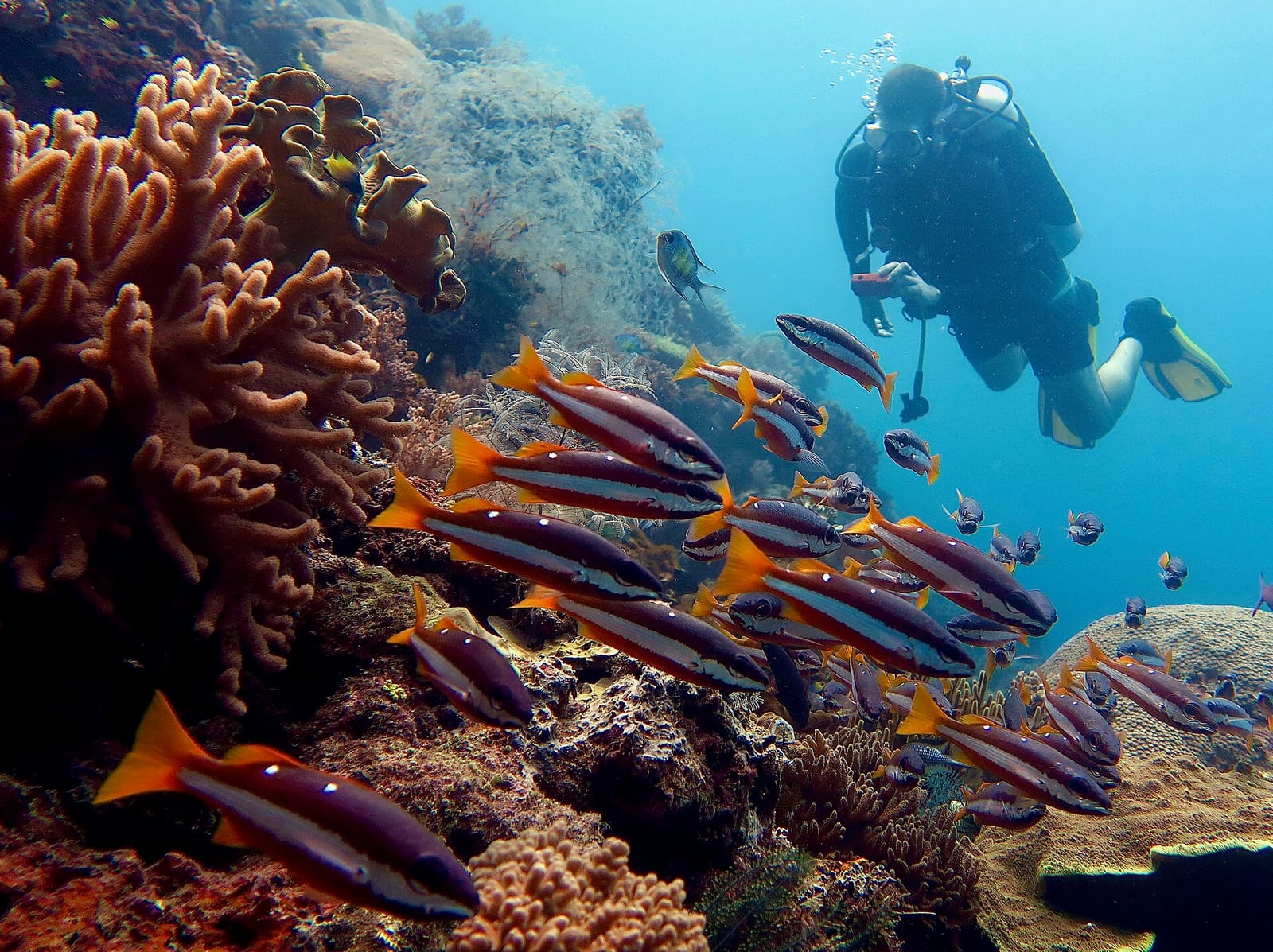
Indonesia sits in the middle of the Coral Triangle. That single fact explains most of what you will see underwater here: 5,000 species of fish and a fifth of the world's reefs, all in the warm water between the Indian and Pacific oceans.
When Dive magazine polled its readers in early 2017 for the ten best dive sites on the planet, three of them were Indonesian. Raja Ampat, Alor and Komodo. One country, three of ten.
The hard part is not finding good diving. It is choosing. Satellite counts put the archipelago at more than 18,000 islands, though only somewhat more than 13,000 have been named and registered with the UN. So let's narrow it down.
Papua and the far east
Raja Ampat, off the Bird's Head Peninsula, is the headline. Conservation International rates it as the most marine-biodiverse place on earth: 553 coral species out of the 798 known worldwide, more than anywhere else in the Coral Triangle.
It is also genuinely remote, which is exactly why it still looks the way it does. You either live on a liveaboard or stay at one of the few resort islands, Misool, Sorido or Arborek.
Further north in Papua, the Padaido islands off Biak hold an undersea cave, coral gardens and World War II wrecks. And in the east of Nusa Tenggara, the Alor Archipelago is about as far off the usual route as Indonesian diving gets.
Bali, Komodo and the islands around them
Bali is where most divers start, and there is no shame in that. Menjangan Island in the north-west, Amed in the east, and Tulamben on the north-east coast, where the USS Liberty lies broken into three parts at different depths, reachable from the beach.
Divers working the Bali sites tend to base themselves at Lovina, Candidasa or Amed. Offshore, Nusa Penida offers the most dramatic diving on the island, and next door Nusa Lembongan is known as a teaching centre, as are the three Gili Islands over toward Lombok.
Then there is Komodo National Park and Flores, where manta rays are the draw.
Sulawesi, Sumatra, Maluku
Sulawesi alone could fill a career. Wall diving at Bunaken near Manado. The Togian Islands in the Gulf of Tomini. The Wakatobi archipelago, far off the beaten path, with an all-inclusive dive resort attached to it. In Gorontalo, whale sharks and the strange Salvador Dali coral sponge.
Pulau Weh, reached from Banda Aceh at the northern tip of Sumatra, may be the most underrated name on this list. The topography runs from boulders on sandy slopes to volcanic pinnacles, craggy wall sections and coral gardens.
The house reef at Gapang Beach is a macro hunter's playground: frogfish, stargazers, gurnards. When the season lines up, mantas, whale sharks and mola mola come through to feed. There is also an active underwater volcano, bubbles and sulphur smell included.
Maluku is the quiet one. Wild dolphins at Lubang Buaya Morela beach in Ambon and an undersea cave at Hukurila, corals in the Banda Islands, the endemic walking shark at Falajawa beach in Ternate, and World War II wreckage at Morotai. Closer to home, Karimunjawa off Java has corals, fish and a wreck of its own.
Water temperature through the year
Warm, and then warm. Across the archipelago the sea sits near 30°C year round, with the flattest water in the April-May and October-December windows and the biggest swell in July and August.
| Month | Sea temperature (°C) | Wave height (m) |
|---|---|---|
| January | 30 | 0.5 |
| February | 30 | 0.4 |
| March | 30 | 0.5 |
| April | 30 | 0.3 |
| May | 30 | 0.3 |
| June | 30 | 0.6 |
| July | 30 | 0.8 |
| August | 29 | 0.8 |
| September | 30 | 0.5 |
| October | 30 | 0.3 |
| November | 30 | 0.3 |
| December | 30 | 0.3 |
Those are broad national averages across a country that stretches from Sumatra to Papua, so treat them as a rough shape rather than a forecast for any one bay. Marine data from Open-Meteo.
What you might actually see
The Wikivoyage guide reads like a wish list once you start pulling the animals out of it.
- Manta rays in Komodo and Flores
- Whale sharks in Gorontalo, and at Pulau Weh in season
- Mola mola at Pulau Weh
- Frogfish, stargazers and gurnards on the Gapang Beach house reef
- Walking sharks at Falajawa beach, Ternate
- Wild dolphins off Lubang Buaya Morela beach, Ambon
- Touchable jellyfish in the barely-salty atoll lake at Derawan, Kalimantan
Planning the trip
Indonesia is the world's largest archipelagic state and the 14th-largest country by area, home to over 280 million people across 38 provinces and more than 700 languages. Sea and air transport are how the islands connect to each other, which is worth remembering when you sketch out a two-week itinerary.
Practically, that means picking one region rather than three. Bali and the Gilis are the easiest to reach and to combine. Raja Ampat, Wakatobi and Alor ask more of you in travel time and reward you with water almost nobody else is in.
Whichever way you go, log it. Drop a pin on the Liberty at Tulamben and note which of the three sections you swam, rate the Bunaken wall, add your Raja Ampat photos so the next diver can see what 553 coral species actually looks like. Start your log at Scubaspot.