Farne Islands: Grey Seals, Dolerite and a Century of Wrecks
Picture a guillemot dropping past you at five metres, wings half-folded, chasing fish. That is a Farnes dive. The birdwatching does not stop when you put your head under.
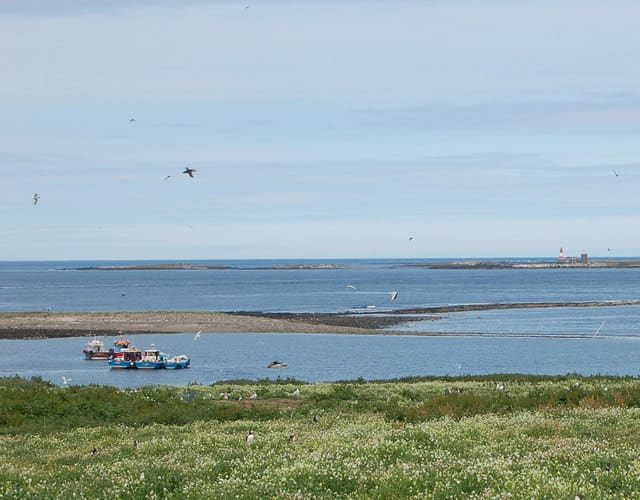
The Farne Islands sit off the Northumberland coast in northeast England, a cluster of somewhere between 15 and 20 islands depending on the tide. Grey seals pup here in large numbers in late autumn. Hundreds of ships have been wrecked on these rocks over the years.
That is the pitch, really. Seals, seabirds and steel, all within a short boat ride of Seahouses harbour.
The lay of the islands
The archipelago splits into two groups, divided by Staple Sound. The Inner Group has Inner Farne, Knoxes Reef, the East and West Wideopens and the slightly detached Megstone. At the lowest tides the Wideopens and Knox's Reef join up into one island.
The Outer Group runs further out: Staple Island, Brownsman, North and South Wamses, Big Harcar and Longstone. Megstone is only about 100 metres long. Inner Farne is the largest and the closest to shore.
The rock itself is resistant igneous dolerite, the same ridge that carries Hadrian's Wall across the country before it dips east and reappears offshore. Dolerite fissures into columns, which is why the cliffs here are so steep and in places vertical, and why the sea around them is scattered with stacks.
The wrecks divers actually visit
Of the scores of wrecks on the Farnes, four get visited routinely by dive boats. Each one is a story of fog, reef and bad luck.
- Chris Christenson, a Danish steamer lost on 16 February 1915, lying close in to the reef off the south tip of Longstone in about 30–35 metres.
- Abessinia, a 138-metre German steamship that drove onto Knifestone on 3 September 1921, now in about 10–20 metres.
- Brittania, a 64-metre British cargo and passenger steamship that struck the Callers in thick fog on 25 September 1915, lying between 10 and 30 metres.
- St Andre, a French steamship carrying pig iron that hit the Crumstone on 28 October 1908, floated off and finally sank at Staple Island, in about 17–25 metres.
Then there is the Pinnacles, where the diving and the birdwatching overlap most directly. Guillemots plunge to around five metres after fish, and you may well be down there when they do it.
One useful quirk of the place: diving at the Farnes is generally possible whatever the wind is doing, because with that many islands and that much broken coastline, shelter is available somewhere.
Seasons and the water
Summer is when the islands are loudest. Eider duck, cormorant, shag, fulmar, kittiwake, Arctic tern, common tern, Sandwich tern, guillemot, razorbill and puffin all breed here. Then in late autumn the grey seals arrive to pup.
| Month | Sea temperature (°C) | Wave height (m) |
|---|---|---|
| January | 7 | 2.7 |
| February | 7 | 2.1 |
| March | 7 | 1.1 |
| April | 8 | 1.2 |
| May | 11 | 1.1 |
| June | 14 | 0.8 |
| July | 16 | 0.9 |
| August | 17 | 1.0 |
| September | 15 | 0.9 |
| October | 13 | 1.5 |
| November | 11 | 1.8 |
| December | 9 | 1.7 |
August is the warmest water of the year at around 17°C, and the calmest average seas fall across June to September. January brings both the biggest swell and water around 7°C. This is North Sea diving, and the numbers say so plainly. The figures come from Open-Meteo marine data.
Above the waterline
The Farnes have no permanent population. National Trust rangers live out here nine months of the year, in Prior Castell's Tower and Lighthouse Cottage on Inner Farne and in the lighthouse cottage on Brownsman.
The human history is strange and good. St Aidan came to Inner Farne in 651, then St Cuthbert, who lived in solitude here and died on the island in 687. In 676 Cuthbert made a decree protecting the eider ducks and other nesting seabirds, thought to be the earliest bird-protection laws anywhere in the world.
Then there is Grace Darling. On 7 September 1838, aged 22, she and her father William, keeper of Longstone Lighthouse, rowed out in a gale and thick fog to the Forfarshire, wrecked on Big Harcar, and rescued nine of the 62 aboard. The story made her a national figure. A museum in Seahouses tells it.
Two lighthouses still work, both automated: Farne Lighthouse of 1811 and Longstone of 1826. Staple Island had two lighthouses built and both were knocked down, one by the Great Storm of 1784 and its replacement by heavy seas in 1800. Ruins of the older lights survive on Brownsman.
Planning a trip
Boats run from Seahouses, and there is a car park by the pier (satnav NE68 7RQ). Allow extra time in case it is full. Landing on the islands is only permitted April to October and needs National Trust permission, usually arranged through one of their accredited operators: Golden Gate, Serenity or Billy Shiels.
Boat trips ran about £30 in 2025, with landing charged on top at £15 adult and £7.50 child in the May to July peak, free for National Trust and NTS members. Non-landing trips carry no extra charge and sail year-round, weather permitting. Wikivoyage keeps the details current.
There are no shops, no food and no drink on the islands, and no camping. Buy what you need in Seahouses and take a picnic, which the gulls will try to steal. Staple Island was closed in 2025 because of avian influenza, so check before you count on it.
If the Farnes are on your list, start a plan in Scubaspot and pin the four wrecks: Chris Christenson, Abessinia, Brittania and St Andre. Log the depth you hit on the Longstone reef, rate the Pinnacles, and post the frame where a guillemot photobombs your seal shot. Your buddy will want to see it at scubaspot.co.