Gili Islands: Three Small Islands Off Lombok
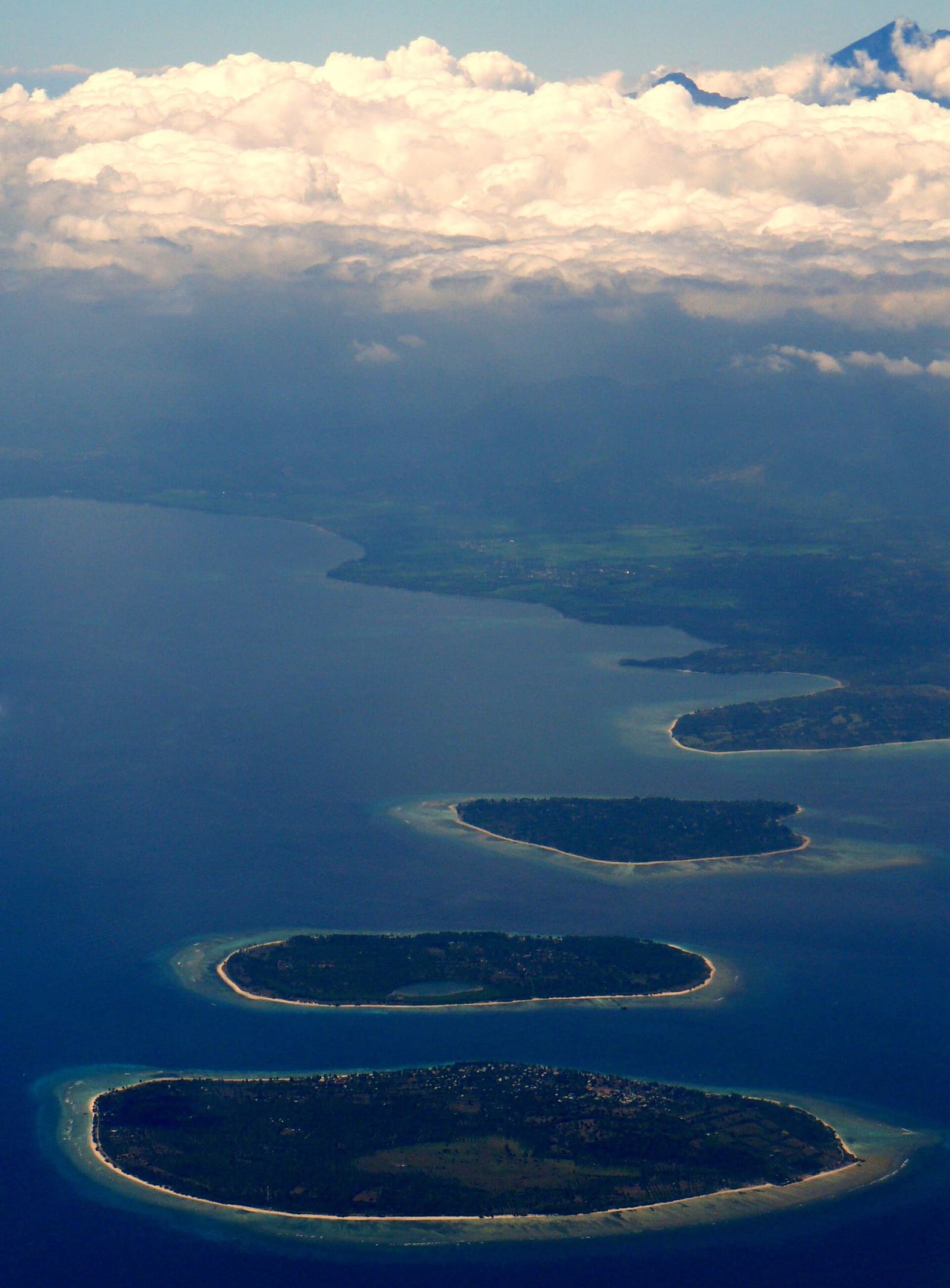
The first thing you notice in the Gilis is what you don't hear. No scooters, no horns, no taxis idling outside the dive shop. Motorized traffic is banned by local ordinance, so you walk to the boat, or you bike, or you take a cidomo, the small horse-drawn carriage that counts as rush hour here.
The second thing you notice is how short the ride out is. Three islands sit just off the northwest coast of Lombok, each with its own cluster of dive shops, and the famous sites are right there: Shark Point, Manta Point, Simon's Reef.
And then there's the one most people miss. A Japanese patrol boat from the Second World War lies at 45 m in the bay south of Gili Air, left over from the period when occupying forces used these islands as a lookout post and a prisoner of war camp.
Three islands, three moods
Gili Trawangan is the big one, 3 km long and 2 km wide, and the only one that rises any distance above the sea at 30 m. Around 1,500 people live there, mostly along the east side, where the accommodation, restaurants and the majority of the dive operations are concentrated.
It got its name from terowongan, Indonesian for tunnel, after a tunnel dug during the Japanese occupation. The base of the anti-aircraft guns still sits at the end of it.
Gili Meno is the middle island and the quiet one, with a population of about 500 and swimming beaches all the way around. It has a turtle sanctuary and a salt-producing lake on the west side that fills in the dry season.
Meno's best-known underwater feature isn't a reef at all. It's a circular arrangement of 48 human statues, standing on the sand, waiting for whoever swims over next. Bring a camera that likes wide angle.
Gili Air is nearest to Lombok and has about 1,800 residents, the largest Indonesian settlement of the three. Turtles patrol the coral reef off the east coast. It's the island people pick when they want neither Trawangan's noise nor Meno's silence, and it has shops, clinics, beach bars and ATMs to match.
What's down there
Diving and freediving are a big part of why people come, drawn by the marine life and the coral formations around all three islands. The reputation was built in the 1990s, when the dive industry here grew fast and the Gilis turned into a serious instruction hub. Trawangan overtook Air as the main base partly because it sat closer to the better dive sites.
The reefs have had a hard time of it. A warm El Niño and unsustainable fishing did real damage, and the growth in visitor numbers since 2009 has added to the pressure. The Gili Eco Trust was set up in 2000 by dive shops on Trawangan together with local community figures, and has run coral restoration, waste management and education projects ever since. You will see that work if you look for it.
For context on how quickly things changed, the island's own record puts Trawangan at 35,000 visitors in 2009 and over a million by 2015.
Seasons and sea temperature
The dry season runs from May to October, with the monsoon from November through April. The Gilis sit between Mount Rinjani on Lombok and Mount Agung on Bali, which gives them a slightly drier microclimate than the islands around them. Air temperatures range from 22°C to 34°C, averaging around 28°C. Peak tourist seasons are July to August and December to January.
| Month | Sea temperature (°C) | Wave height (m) |
|---|---|---|
| January | 29 | 1.2 |
| February | 29 | 1.0 |
| March | 29 | 0.9 |
| April | 30 | 0.6 |
| May | 30 | 0.7 |
| June | 29 | 0.8 |
| July | 28 | 0.8 |
| August | 28 | 1.0 |
| September | 28 | 0.8 |
| October | 30 | 0.8 |
| November | 30 | 0.8 |
| December | 30 | 0.8 |
The water barely moves off 28 to 30°C all year, which is the sort of table that makes trip planning pleasantly boring. Wave height peaks in January and eases through April and May. These figures come from Open-Meteo marine data for 2026.
Getting there
There are no airports on the Gilis. Most people fly into Bali and cross by boat, which is often cheaper and better connected than flying into Lombok. From Ngurah Rai in Bali to Lombok International is about 40 minutes in the air, then roughly two hours by road to Bangsal and 20 to 30 minutes on a local boat.
Fast boats started running from Bali in 2005 and now leave from several ports. Serangan to Lombok takes about 2 hours 30 minutes. Padang Bai has the most services and the shortest crossings, with tickets from Ubud around Rp 250,000 one-way or Rp 450,000 with an open-ended return including hotel pickup.
The cheap option is the hourly public ferry from Padang Bai to Lembar, 5 to 6 hours for Rp 60,000, then a further two-hour transfer by road and local boat. Wikivoyage's guide suggests reaching Teluk Nare or Bangsal by 16:00 for a straightforward crossing. A taxi from Lombok airport runs about Rp 300,000 to 400,000.
Planning it
Pick your island first, because it shapes the whole trip. Trawangan for the widest choice of dive shops and the liveliest evenings, Air for turtles and a middle ground, Meno if you want to hear the sea at night. Boats run between all three, so you are not locked in. Accommodation now spans backpacker huts to honeymoon territory, and there is no high-rise anywhere.
Going? Log Shark Point and Simon's Reef as you dive them, note the depth you saw the Gili Meno statues at, and post the turtle shot from Air's east coast to your feed so the next diver knows where to look. Start your Gili trip log at Scubaspot.