Gorgona Island: Colombia's Pacific Park, Snakes, Whales and All
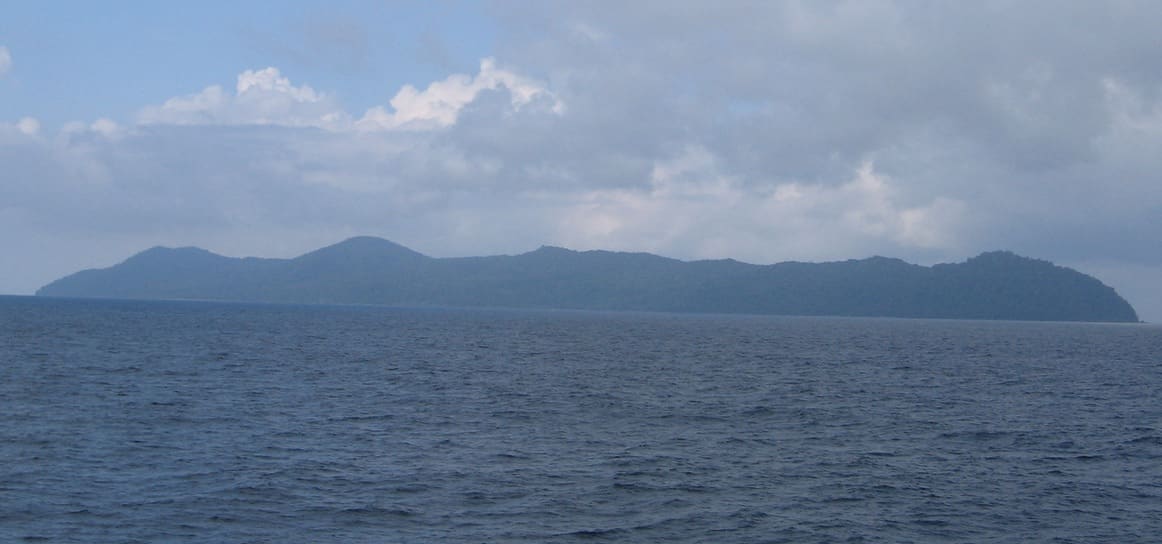
Picture a jungle-covered rock 28 km off Colombia's Pacific coast, with a cloud more or less permanently parked on its summit. Rain almost every day. Venomous snakes in the interior that once did the work of prison walls.
That is Gorgona. And the reason divers go is what happens offshore: coral reefs, hammerheads, whitetip reef sharks, whale sharks, turtles, and humpback whales passing by from August to October with their newborn calves.
The island is 9 km long and 2.5 km across at its widest, separated from the mainland by a 270 m deep underwater depression. That drop-off matters. It is part of why pelagic life shows up here at all.
A prison island, then a park
Gorgona's human history is strange enough to carry a whole dinner conversation. Francisco Pizarro sat out seven months here in 1527, waiting on provisions before continuing to Peru. He lost men to snakebite, called the place an inferno, and named it after Medusa and her serpent hair.
Pirates used it too. Bartholomew Sharp took it over in 1679 and renamed it after himself for about a month. Woodes Rogers and William Dampier sheltered here in 1709. Fresh water and good timber made it a useful stop on the Panama–Peru run.
Then, in 1959, Colombia turned it into a high-security prison, built on the model of Nazi concentration camps, and divers today still hear it called Colombia's Alcatraz. Prisoners slept on beds with no mattress. The snakes inland and the sharks in the channel were the deterrent. It closed on 25 June 1984, and the park was declared the following year.
The old jail buildings are still there, mostly eaten by vegetation. A portion is visible. Walking past them on the way to a dive is not something you forget, and you can read the longer version of the story on Wikipedia).
What is in the water
The park covers 620 square kilometres of sea. Around the island you will find hammerhead sharks, whitetip reef sharks, whale sharks, sea turtles and moray eels, plus the offshore coral reefs the park was created to protect.
The headline act is the humpback whale. They arrive on their southward migration from August to October, and they bring calves. Even on the surface interval you may hear them.
Above water, Gorgona is an Important Bird Area. Brown pelicans, magnificent frigatebirds and blue-footed boobies all hold significant populations here. The brown booby colony is small, around 150 pairs recorded in 2002, but it is the most important breeding territory in the world for its subspecies.
The shape of the island
East side: white sand beaches made of broken-down coral. West side: cliffs taking the full weight of the open Pacific, with a couple of sandy beaches tucked in. Pizarro Beach on the northeastern shore is where the conquistador is thought to have come ashore.
To the southwest is the smaller island of Gorgonilla, separated by the 400 m Tasca strait. Before the earthquake of 31 March 1983 you could walk across at low tide. Not anymore.
Rock islets rise almost vertically out of the water at the northern tip, the Rocas del Horno. El Viudo, the Widower, stands southwest of Gorgonilla. The high point of the island is Cerro La Trinidad at 338 m.
One for the geology nerds: the youngest known komatiites on Earth are found on Gorgona, volcanic rocks otherwise almost unique to the Archean. And on Gorgonilla's southern tip there is a layer of glassy spherules thrown out by the Chicxulub impact. The rock that killed the dinosaurs left its fingerprint on this island.
Weather and water
Average air temperature is 26°C and average humidity 90%. Annual rainfall is calculated at 6,948.5 mm. It rains all year, heaviest in May and June, least in February and March. The sea stays warm the whole way round the calendar.
| Month | Sea temperature (°C) | Wave height (m) |
|---|---|---|
| January | 27 | 1.0 |
| February | 27 | 0.9 |
| March | 27 | 0.8 |
| April | 28 | 0.7 |
| May | 29 | 0.9 |
| June | 29 | 0.9 |
| July | 30 | 0.9 |
| August | 29 | 1.0 |
| September | 29 | 0.9 |
| October | 28 | 1.1 |
| November | 28 | 1.1 |
| December | 28 | 1.0 |
Warmest water lines up roughly with whale season, which is a convenient coincidence. The driest stretch, February and March, is also when the sea is at its flattest in this data.
Getting there and staying
Gorgona has no permanent population beyond park staff. You need permission in advance to visit, and the island can host around 80 people at a time. Administratively it belongs to the Municipality of Guapi, in the Department of Cauca.
Camping is not allowed. The only accommodation is run by the park administration at El Poblado, the single settlement, facing the ocean. There is a restaurant. It is a very quiet place.
Each group gets a guide on arrival who goes with them wherever they go. Because of the snakes, you cannot set foot anywhere unaccompanied or without boots, with the beach in front of the rooms the only exception. Plan around that rather than against it.
Book the permit early, pick your window, and decide whether you are coming for the humpbacks or the drier skies of February and March. You cannot have both.
When you get there, log your Gorgona dives in Scubaspot while the hammerheads are still fresh in your mind. Note the depth on the reef, tag the whale sightings by date so other divers can see how the August to October window actually played out, and add a shot of the jungle-swallowed prison walls on your way back to the rooms.