Hurghada: Egypt's Red Sea City of Offshore Reefs and Wrecks
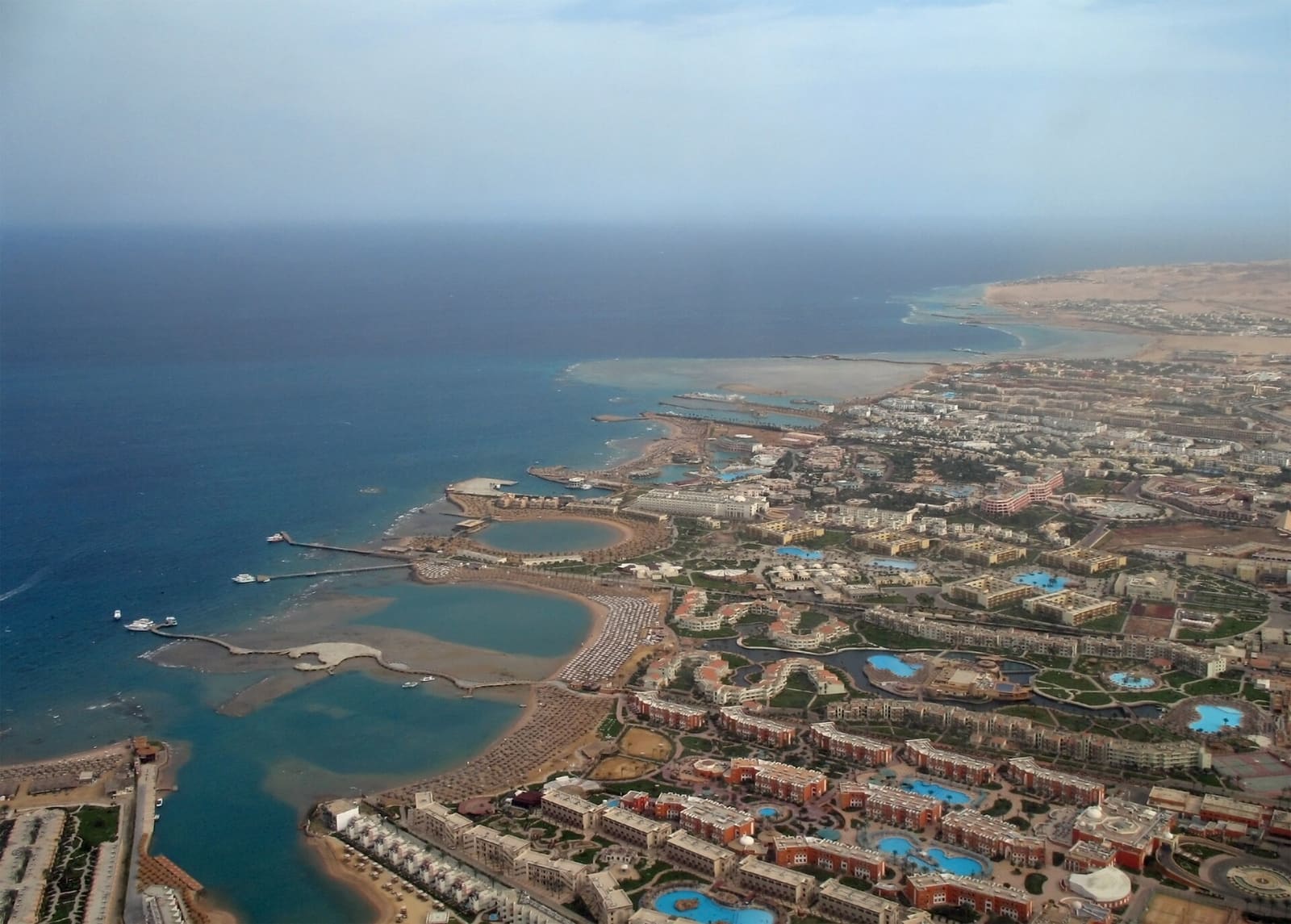
In Hurghada, the reef does not come to you. Unlike the Sinai resorts or Jordan, where coral hugs the shoreline, Hurghada's reefs sit several miles offshore. That single geographic fact shapes everything: your day starts at a marina, not a beach entry.
What you get in return is a spread of arid islands scattered across open water, with dive sites around Giftun, Abu Ramada and Fanadir, and wrecks including the El Mina and the Rosalie Moller.
And it is all reachable from one of the busiest airports in Egypt, in a city that stretches close to 40 km along the coast and draws over 9 million visitors a year.
A city built the long way
Hurghada began as a small fishing village, settled by Ababda fishermen along the natural harbor in the Sekalla area in the late 19th century. The city was officially established in 1905. Oil turned up in 1913. Then, from the 1980s, Egyptian and foreign investment turned the place into a Red Sea resort city.
Today it runs about 36 kilometres along the coast without reaching far into the desert behind it. Ad-Dahar in the north is the oldest, most Egyptian part of town, with the traditional bazaar, post office and long-distance bus stations. A low dusty ridge separates it from Sigala, 4 km south.
Sigala is where most divers end up. It is the main downtown strip with the most buzz, and several boat and dive operators run from the marina there. Sheraton Road continues south past the disused circular 1970s hulk of the old Sheraton Hotel into the resort strip.
The islands and what sits around them
Hurghada's waters contain the islands of Giftun, Umm Qamar, Magawish, Abu Ramada, Abu Minqar, Fanadir and Shadwan. Big Giftun is the largest, and it has something divers quietly appreciate: cellphone towers, so reception out on the water is good for skippers and day-trippers alike.
Giftun is also protected, and El Mahmya is a beachfront camp on the island, about 45 minutes by boat from Hurghada.
Shadwan Island, east of the city, carries a different kind of history. During the War of Attrition it was fortified by Egyptian troops and used as a radar post, and on 22 January 1970 it was the site of Operation Rhodes, an Israeli helicopter assault that occupied the island for 36 hours.
One thing worth knowing before you go: tourism has taken a toll here. A study cited by Wikipedia found the reefs have declined by 50% in three decades, with oil spills, pollution, sewage and dredging all playing a part.
The bays up and down the coast
Most divers do not actually stay in Hurghada proper. The metropolitan area strings together resort towns north and south, all of them using Hurghada airport as the way in.
- El Gouna, about 25 km north: a privately owned hotel town of islands, channels and bridges, with dive and watersports centers and three marinas
- Sahl Hasheesh, 18 km south: clear long descending seas and diverse marine life around artificial underwater walls
- Makadi Bay, 30 km south: hotels, shops and clubs, a good sandy beach, and no local settlements
- Sharm El Naga, around 40 km south: a village whose beach has a striking reef cliff
- Soma Bay, 45 km south: a resort area with a cluster of hotels
Further down the coast, between Hurghada and Marsa Alam, El Qoseir is one of the oldest cities on the Red Sea's western shore. It was Myos Hormos to the Romans, and its old quarter still holds an Ottoman fort, historic mosques and the water reservoir that was the town's only drinking water a century ago.
Weather and water through the year
Hurghada has a subtropical-desert climate. Winters are mild to warm, summers hot to very hot, and rain is rare. December through February is warm by day, though evenings can drop from around 20 °C to 10. November, March and April are comfortably warm; May and October are hot; June to September is very hot. The Shamal wind blowing down from the northeast can make the city feel downright cold.
The sea averages 24 °C across the year, ranging from 21 °C in February and March up to 28 °C in August.
| Month | Sea temperature (°C) | Wave height (m) |
|---|---|---|
| January | 23 | 0.6 |
| February | 22 | 0.7 |
| March | 22 | 0.7 |
| April | 23 | 0.7 |
| May | 24 | 0.8 |
| June | 26 | 0.8 |
| July | 28 | 0.7 |
| August | 29 | 0.6 |
| September | 28 | 0.8 |
| October | 27 | 0.7 |
| November | 26 | 0.5 |
| December | 24 | 0.7 |
Modelled wave heights sit between 0.5 and 0.8 m all year, which matches the city's reputation for water that is clear and calm for most of the year. November is the flattest month in the data, August the warmest. Figures come from Open-Meteo.
Getting there and getting around
Hurghada International Airport is Egypt's second-busiest, about 8 km west of the resort strip and roughly 10 km from Sigala. There are frequent direct international flights from Europe, Russia, Turkey, the Gulf states and as far as Bangkok, plus ultra low-cost services from Rome and Budapest. Many passengers are on package tours, but operators sell flight-only tickets too.
Domestic flights connect frequently to Cairo and daily to Alexandria and Sharm el-Sheikh. That matters, because Hurghada is backed by a great deal of desert and the road journeys are long. Cairo is 455 km away by the Hurghada-Sokhna-Cairo road.
There is no local bus or microbus leaving directly from the airport terminal, so sort out your transfer before you land. Free airport Wi-Fi runs for a short period only, and SIM cards with data may be sold in the arrivals area, with a passport required for registration.
Planning a trip
Pick your base first, because the bays are genuinely different places: El Gouna north, Sahl Hasheesh and Makadi and Soma south, Sigala in the middle if you want the marina and the restaurants within walking distance. Then think about when. Sea temperatures peak in August and bottom out in February and March.
Plenty of visitors also tack on Luxor or Cairo, and local operators run day trips and excursions to both. Back in town there is the Hurghada Museum, the first antiquities museum in the Red Sea Governorate with 2,000 artifacts, and the Grand Aquarium, which opened in 2015 as the largest in Egypt.
When you get out to Giftun or find yourself finning along the Rosalie Moller, log the dive and drop your photos into Scubaspot. Rate the sites around Abu Ramada and Fanadir so the next diver knows which boat to book, and tag the buddy you talked into coming with you.