Isle of Noss: Shetland's Seabird Island, Seen From the Water
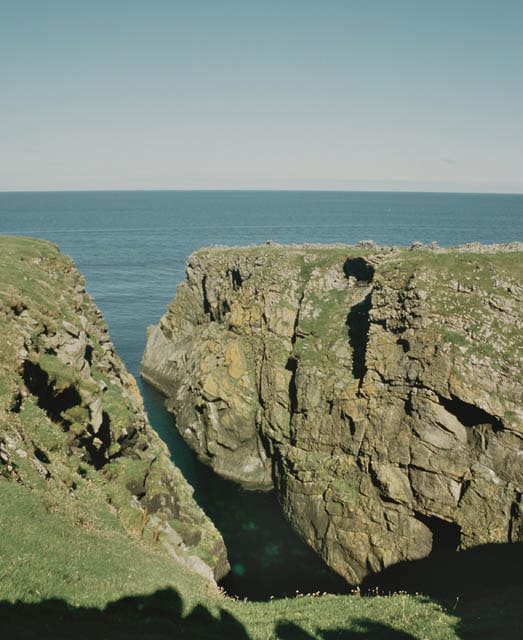
Picture a wall of layered sandstone rising out of the North Atlantic, every horizontal ledge occupied by a bird. That is the Noup of Noss, and locals call it the Great Wall of Noss. It was first climbed by Jo Moran in 1963.
Noss is small. Some 343.83 hectares, no permanent residents since 1939, a national nature reserve since 1955. It sits off Bressay in Shetland, separated from it by the narrow Noss Sound.
So why should a diver care about a sheep farm with birds on it? Because the water around Noss is alive in the way cold northern water can be: otters along the shoreline, grey and common seals, and ten species of cetacean recorded offshore. The island is the frame. The sea does the rest.
A nose, not an island
The name comes from the Old Norse word for nose. That detail matters more than it sounds. Most Shetland islands of a similar size were named with the Norse word for island attached, and Noss was not.
The reading is that Noss was once a peninsula joined to Bressay, and that somewhere between the Viking arrival and the 16th century the sea took the isthmus away. You are looking at a place the Atlantic physically detached.
There were people here. Twenty of them in 1851, clustered on the low western side at Gungstie, a name that simply means a landing place. Gungstie was built in the 1670s and the seasonal wildlife wardens use it now. A second settlement at Setter, in the southeast, was lived in until the 1870s and lies derelict.
What is on the island
Noss is run by NatureScot and is one of the more accessible of the internationally important seabird colonies in the North Atlantic. The sandstone cliffs weather into shelves, and those shelves are the reason the colonies are so large.
The regulars on the ledges:
- Gannets
- Puffins
- Guillemots
- Shags
- Black-legged kittiwakes
- Razorbills
- Northern fulmars
- Great skuas
Two hundred and one bird species have been recorded in total. Waders breed here too, including dunlin, common snipe, oystercatcher and ringed plover. Skylark, meadow pipit, rock pipit and wheatear fill in the moorland.
The cast has shifted over a century. Gannet, fulmar, great skua and storm petrel all started breeding here. Six species stopped, among them the peregrine falcon and the white-tailed eagle.
On land there is a visitor centre, the Pony Pund built for breeding Shetland ponies, and the Holm of Noss, a detached rock stack. Plant life is quietly rich: 137 vascular plant species, 25 fungi and lichens, 44 mosses and liverworts, 30 species of algae. Small adder's-tongue and northern knotgrass are both nationally scarce, as is the lichen Lecanora straminea.
In and around the water
Otters are seen frequently around the island. Grey and common seals turn up in small numbers. Ten cetacean species have been recorded in the surrounding sea, and the one you are most likely to meet is the harbour porpoise.
Noss carries about as many conservation labels as an island can: Special Protection Area, Site of Special Scientific Interest, IUCN Category IV, and an Important Bird Area under BirdLife International. Read the full picture of the reserve before you go and you will get more out of the trip.
Sea temperature and swell through the year
| Month | Sea temperature (°C) | Wave height (m) |
|---|---|---|
| January | 9 | 3.2 |
| February | 8 | 2.7 |
| March | 8 | 2.1 |
| April | 9 | 1.8 |
| May | 9 | 1.3 |
| June | 12 | 1.0 |
| July | 14 | 0.9 |
| August | 14 | 1.0 |
| September | 13 | 1.8 |
| October | 12 | 2.1 |
| November | 11 | 1.9 |
| December | 10 | 2.3 |
The pattern is about as clean as marine data gets. July and August are the warmest at 14°C and the flattest at around 0.9 to 1.0 metres of wave height. January is the other end: 8.6°C and 3.2 metres. The shoulder months of May and September sit in between, with September holding 13°C water but nearly twice the swell of July.
Getting there and planning around it
Noss connects to Bressay by a seasonal ferry run by the wildlife wardens in an inflatable boat. It carries roughly 1,700 people to the island each year. Counting private and commercial boats, total visitor numbers are thought to be around 5,000 annually.
That is a very small number of people for a place this striking, and it tells you something about the season. The ferry is seasonal, the wardens are seasonal, and the calm water is seasonal too. Line those three up and you have your window.
The island's position is 60.146°N, 1.019°W. Shetland, Scotland, and far enough north that the summer light stretches long.
If Noss makes your Shetland list, log your dives with Scubaspot when you get there. Note the sea temperature you actually found against the table above, tag the otters and porpoises you spot, and add a shot of the Noup ledges for the divers who follow you. Start at scubaspot.co.