Nusa Lembongan: Reef Diving 30 Minutes From Bali
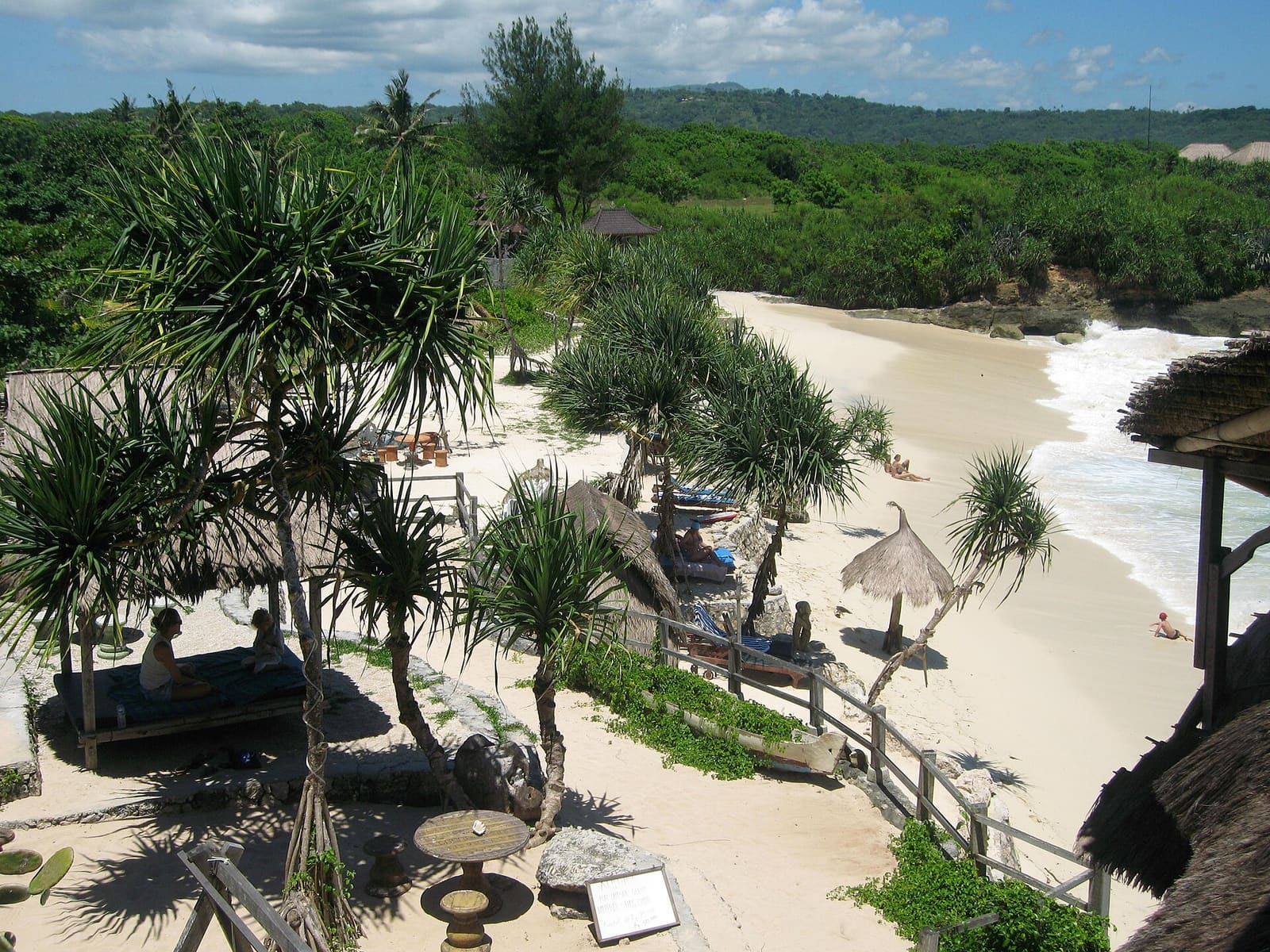
Twelve kilometres of the Badung Strait separate Nusa Lembongan from Bali. That short crossing changes everything. No traffic, no hawkers, no South Bali pace.
What it does have is reef. The waters around Lembongan and neighbouring Nusa Penida hold at least 247 species of coral and 562 species of reef fish. That is the number worth carrying in your head when you decide where to go next.
And the water itself. Wikivoyage calls it some of the clearest you will find anywhere, a vivid aqua blue. It is the kind of description that sounds like marketing until you are in it.
A very small island
Nusa Lembongan covers about 8 square kilometres and has a permanent population estimated at 5,000. It is the most famous of the three Nusa Islands, alongside much larger Nusa Penida and tiny Nusa Ceningan.
Coral reefs ring the island. Above the water you get white sand beaches and low limestone cliffs, and no permanent waterways at all. A suspension bridge, opened in 2017, links Lembongan to Nusa Ceningan and carries foot and motorbike traffic only.
There are very few cars. Scooters and your own feet do the work.
Where you will actually stay
Three main villages, and two of them are where visitors end up.
- Jungut Batu, northwest, the bigger of the two beach areas, with hotels and cheap eateries and the island's busiest road running parallel to the beach
- The Bukit, the hillside south of Jungut Batu, with higher-end hotels and villas and views that Wikivoyage rates second to none on the island
- Mushroom Bay, southwest, a sheltered bay with a great white sand beach and small waterside restaurants, and best after 15:00 when the day trippers have gone
- Dream Beach and Sunset Beach, either side of the Devil's Tear outcrop, in a hillier area with dramatic cave formations
- Lembongan Village in the southern interior, where most of the permanent local population lives
The northeastern side of the island is flanked by roughly 212 hectares of mangroves. The north end is fringed by that forest too, and a shallow estuarine channel separates Lembongan from Nusa Ceningan. At low tide the channel is difficult to navigate.
On the Wallace Line
Here is the detail that makes Lembongan more interesting than its size suggests. To the east, the Lombok Strait marks the biogeographical division between the fauna of the Indomalayan realm and the very different fauna of Australasia.
That boundary is the Wallace Line, named for Alfred Russel Wallace, who first proposed a transition zone between the two biomes. You are diving on the edge of it. Read more on the Wikipedia entry for the island.
Seasons and sea
The climate is similar to mainland Bali, but noticeably drier on Lembongan, particularly from May to September. The time to avoid, if there is one, is the height of the rainy season in January and February.
| Month | Sea temperature (°C) | Wave height (m) |
|---|---|---|
| January | 29 | 1.6 |
| February | 29 | 1.6 |
| March | 29 | 1.6 |
| April | 29 | 1.4 |
| May | 29 | 1.5 |
| June | 28 | 1.8 |
| July | 28 | 1.8 |
| August | 27 | 2.0 |
| September | 28 | 1.7 |
| October | 29 | 1.6 |
| November | 30 | 1.3 |
| December | 30 | 1.4 |
The sea barely moves off a warm 27 to 30 degrees all year. What does move is the swell: highest around August at 2.0 m, lowest in November at 1.3 m. Worth weighing against the drier months when you pick dates.
Conservation and the seaweed
Marine conservation is taken seriously here, because tourism depends on it. In February 2009 a local NGO, facilitated by The Nature Conservancy Coral Triangle Center, opened a community centre on the island. There is also a release programme for vulnerable olive ridley turtles from Sunset Beach on the southwestern coast.
Seaweed farming was once a micro-industry here. It became unviable around 2015 as tourism and pollution took their toll. Then the pandemic emptied the island of visitors, and locals returned to the practice in 2020 and 2021, rebuilding the farms. Many visitors find it genuinely interesting to learn about.
Getting there
Boat, unless you charter a helicopter. Scheduled fast boats run from Sanur Harbour and Serangan in South Bali, plus a couple of services from Padang Bai in East Bali. Crossing time from Sanur is about 30 minutes, at regular intervals during daylight hours.
As of 2021 there were over 20 different fast boat operators serving Lembongan, and standards vary widely. You can book at an operator's office near the departure point, or online in advance. Larger cargo boats also run daily from Padang Bai.
The local Lembonganese are Hindu, and you will notice little difference from mainland Bali. Balinese is the most common language between residents, in a distinct local dialect, with Bahasa Indonesia a distant second. English is widely understood, often with an Australian accent.
Planning it
Pick your window between the drier May-to-September stretch and the calmer swell of November and December. Base yourself in Jungut Batu if you want eateries and noise, Mushroom Bay if you want quiet after three in the afternoon. Rent a scooter. Walk the suspension bridge to Ceningan.
When you get back on the boat to Sanur, log the dives in Scubaspot while the crossing is still short. Rate the reef sites, note the sea temperature you actually saw, and add your photos of the mangrove fringe and the limestone cliffs at Devil's Tear. With 562 reef fish species out there, your species list is going to need somewhere to live.