Ponce de Leon Springs: 68 degrees, every day of the year
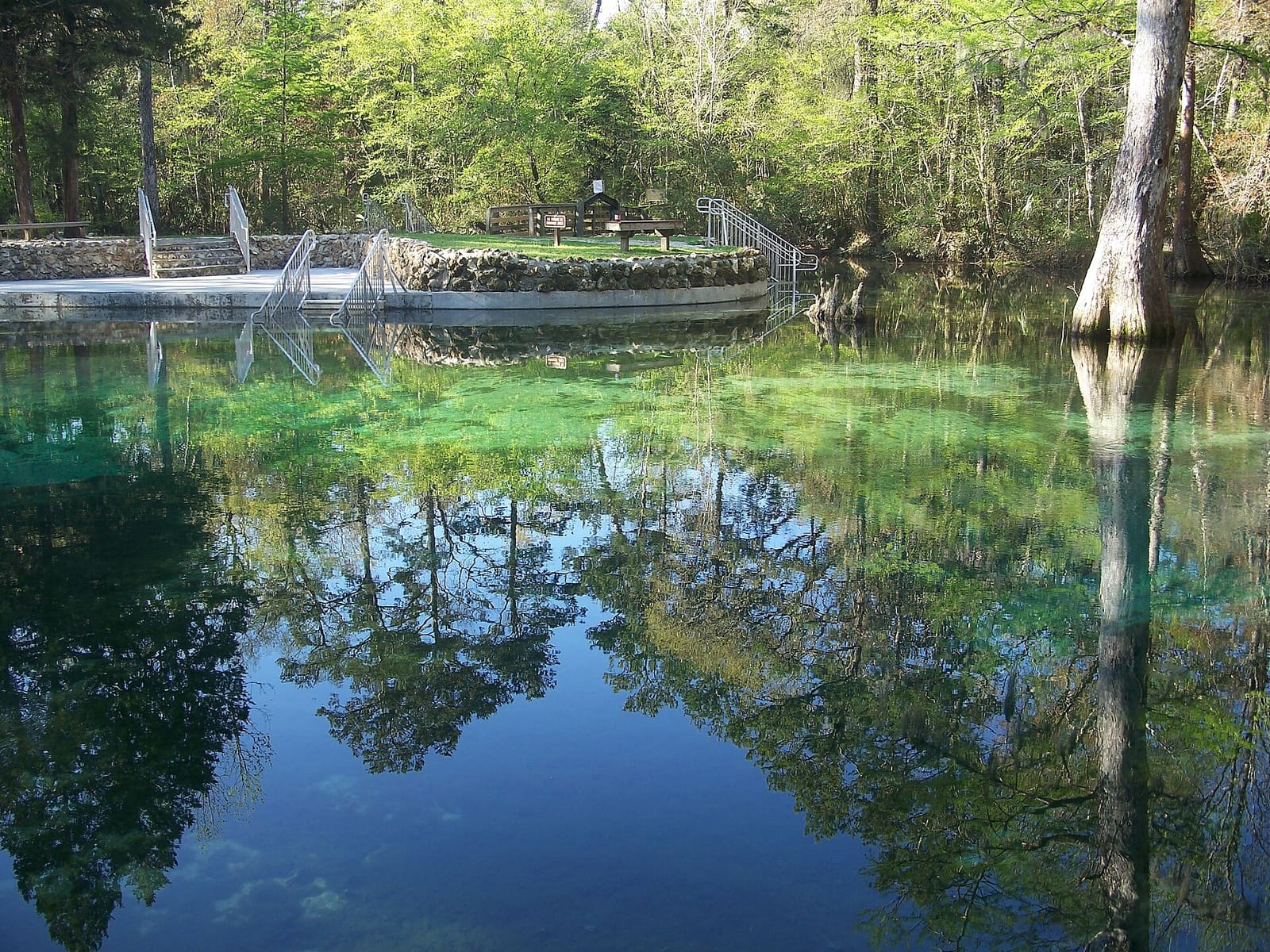
Here is the number that matters: 68 °F. Not in summer, not in spring. Always.
Ponce de Leon Springs sits in Holmes County, in the Florida Panhandle, and it does what every spring fed by the Floridan aquifer does. It pushes cold, clear groundwater to the surface at the same temperature all year, whatever the season is doing above it.
If you collect Florida springs, this is a small one with a long memory. Around 14 million gallons a day come out of a vent about 20 feet below the surface, then run off down a spring-run stream roughly 350 feet long. The park grants visitors two things: swimming in the spring and walking the nature trails.
The spring itself
It is classed as a second-magnitude spring. The vent at the head concentrates the groundwater discharge, and that is the deepest point at about 20 feet.
Underneath all of it is Ocala limestone, first described in its namesake town of Ocala. In Florida it is soft, white, porous and, as early descriptions put it, apparently very pure. That porosity is the whole story of this landscape: water moves through rock instead of over it, which is why the spring runs clear.
The aquifer behind it is enormous. The Floridan aquifer system covers around 100,000 square miles across four southeastern states and holds some 3,500 feet of limestone and dolomite. It is often called the largest, oldest and deepest aquifer in the southeastern United States.
Fountain of youth, allegedly
The spring carries Juan Ponce de León's name. He led the first Spanish expedition to Florida in 1513, and the story goes that he was chasing a spring from a Taino legend that would restore youth to anyone who bathed in it. Hence the unofficial nickname, the Fountain of Youth.
He almost certainly never stood here. People did, though, long before him. The Chatot and the Chisca lived in this area, the Chisca thought to have been Yuchi people who left the Appalachian Highlands during the colonial wars of the 1650s and settled near the Choctawhatchee River.
The Chatot held territory from the Chattahoochee to the Choctawhatchee. By the account of a 1639 letter from Florida's governor, they were a people who never maintained peace with anybody.
A hotel, and then a war
Once Spanish settlers arrived, the clear water drew people in for fishing, drinking and swimming. A log hotel went up in 1840 and families followed.
It did not last. On September 24, 1864, around 700 Union soldiers under Brigadier General Alexander Asboth stopped at the springs on their way to the Battle of Marianna. They burned the hotel and looted the houses nearby.
The raiding force took its first loss close to the park, and Private Joseph Williams of Company H, 86th U.S. Colored Infantry, was mortally wounded in an accidental shooting near here. You can read the fuller version on the park's Wikipedia entry.
The park around the water
The park covers 386.94 acres across Holmes and Walton counties, and the walking is a genuine reason to come, not a consolation prize. Four rare pitcher plants grow in the wetland areas: parrot, purple, red and trumpet-leaf. The red pitcher plant was reintroduced in 2010 after staff kept restoring the seepage slope community until it could take hold again.
There are also flame azalea, mountain laurel, longleaf pine, and more than 40 acres of historic turpentine woodlands. Up on the higher ground you get rhododendron, red chokeberry, hickory, huckleberry, blazing star, aster, oaks, pines and blueberry.
Animals you might see:
- Gopher tortoise
- White-tailed deer
- Beaver and otter
- Bobcat and fox
- Turkey, plus native and migratory birds
- Catfish, largemouth bass, chain pickerel and panfish
- American alligators, whose presence is marked by park signage
The park's plants and animals are protected under Florida statute 258.008. Breaking off water-bottom formations, collecting specimens or disturbing wildlife without permission is a second-degree misdemeanor. Leave the limestone where it is.
Getting there
The park is north of Interstate 10 in the town of Ponce de Leon, reached off Holmes County Road 181A from U.S. 90. Two self-guided nature trails run from it, Spring Run and Sandy Creek, both walkable and bike accessible. Rangers lead guided walks seasonally.
Florida bought the land on September 4, 1970, using the Land Acquisition Trust Fund, with nature appreciation and wildlife viewing written into the purpose.
If you make the trip, log it in Scubaspot and note the temperature at the vent, because it will read 68 °F no matter what month you went. Add a photo of the spring run and tell the feed whether you spotted the red pitcher plants.