SS Carl D. Bradley: The Queen of the Lakes, Broken in Two
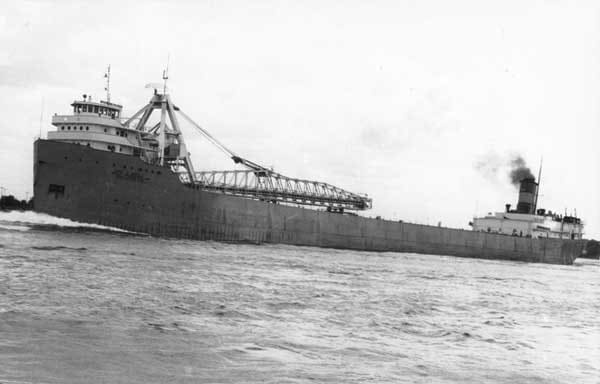
At 5:35 p.m. on November 18, 1958, the first mate of the Carl D. Bradley heard a thud, felt a vibration, and turned to look aft. The stern of his ship was sagging. She was 639 feet long and she was coming apart.
That is why this wreck still matters. Not because she was pretty, but because she was the biggest thing on the Great Lakes for 22 years, and she folded in the middle while her crew was riding comfortably.
Thirty-five men were aboard. Thirty-three died. Twenty-three of them came from one town, Rogers City, Michigan, where many of the crew were friends, neighbors or relatives of one another. Few wrecks anywhere carry a grief that concentrated.
Queen of the Lakes
She was built as hull 797 at the American Ship Building Company in Lorain, Ohio, and launched on April 9, 1927. Her namesake, Carl David Bradley, president of Michigan Limestone, called her "the last word in freighter construction."
He had reason to. She beat the next largest ship on the lakes by seven feet. Her engine had nearly twice the power of most lake freighters. She was the only fully electric ship in the Bradley Transportation fleet, with one generator driving everything from the propeller to the running lights.
She held the title Queen of the Lakes until the 678-foot Wilfred Sykes launched in 1949. When she steamed into Calcite Harbor on her maiden voyage on July 28, 1927, the Rogers City community band and hundreds of residents turned out to meet her.
She was the fleet flagship and looked it. Fresh gray and red paint, decks hosed down, a galley with huge refrigeration units, private rooms for the officers. Corporate guests rode in her staterooms.
And she worked. In 1929 she loaded 18,114 long tons of limestone, a cargo that would have needed 300 railroad cars. In 1943 she was the first lake freighter through the new MacArthur Lock at the Soo. When ice kept smaller vessels in port, she went first, forepeak filled with concrete, breaking a path to Indiana and then limping to Lorain to have her broken plates replaced.
Held together by rust
Thirty-one years of that leaves marks. Her crew joked that she was held together by her rust. Sailors said they picked up sheared-off rivets by the bucketful after storms, because she twisted and bent so much in heavy weather.
She had taken damage in a collision with the MV White Rose on the St. Clair River in April 1957, spent seven days in dry dock in Chicago the following month, and grounded twice at Cedarville in 1958. Neither grounding was reported to the Coast Guard. U.S. Steel had already budgeted $800,000 to replace her rusting cargo hold and bulkheads that winter.
Captain Roland Bryan knew. In a letter to a friend not long before the end, he wrote that the ship was not in good structural condition and should not be out in bad weather, and that he was glad she was getting a new hold at Manitowoc.
The last trip home
She left Gary, Indiana, empty at 10 p.m. on November 17, carrying 9,000 gallons of ballast, bound for her winter layup. Hours from Manitowoc, U.S. Steel ordered her to turn around for one more load of stone.
The storm she sailed into was two weather systems merging. Thirty tornadoes from Illinois to Texas. More than a foot of snow in the Dakotas. A record 6.4 inches in Tucson, Arizona.
Bryan took the lee of the Wisconsin shore to duck the worst of it. By 4 p.m. she was past Poverty Island with storm-force winds from the southwest. At 5:35 p.m. she was about 10 nautical miles southwest of Gull Island when she broke.
The German freighter Christian Sartori watched through binoculars. The forward lights went out, then the aft lights, then an explosion and a column of red, yellow and white flame.
The bow section's life raft was thrown clear as she went down. Four men reached it. The waves threw them off again and again. At 8:37 a.m. on November 19, the cutter Sundew found the raft 15 nautical miles from the site with two men alive on it: First Mate Elmer Fleming, 43, and Deck Watchman Frank Mays, 26.
They had fired two of their three flares. The third was wet and would not light when Christian Sartori passed within 100 yards without seeing them. The full account is worth reading before you go.
What is down there
She lies in northern Lake Michigan at 45.559, -85.988, in two pieces, the way the first mate last saw her. The break is the dive. Her cargo spaces ran open through the tunnel and conveyor room for 475 feet, divided only by screen bulkheads, and the Coast Guard's description of that arrangement reads very differently once you know how the ship ended.
Cold fresh water keeps Great Lakes wrecks honest. What you find here is a 1927 self-unloader with her machinery aft and her forepeak forward, still wearing the shape that made her the biggest ship on the lakes for more than two decades.
Remember what she is, too. Thirty-three men never came home, and on the night it happened their families lined the beach at Charlevoix with their car headlights on, waiting.
If you make it out to her, log the dive in Scubaspot and note where the hull separates, so the next diver knows what to look for. Photos of the two sections and the conveyor room are the ones people want to see. Add them, rate the site, and tag the buddy you are already talking into going.