SS Persier: The Food Ship That Never Reached Belgium
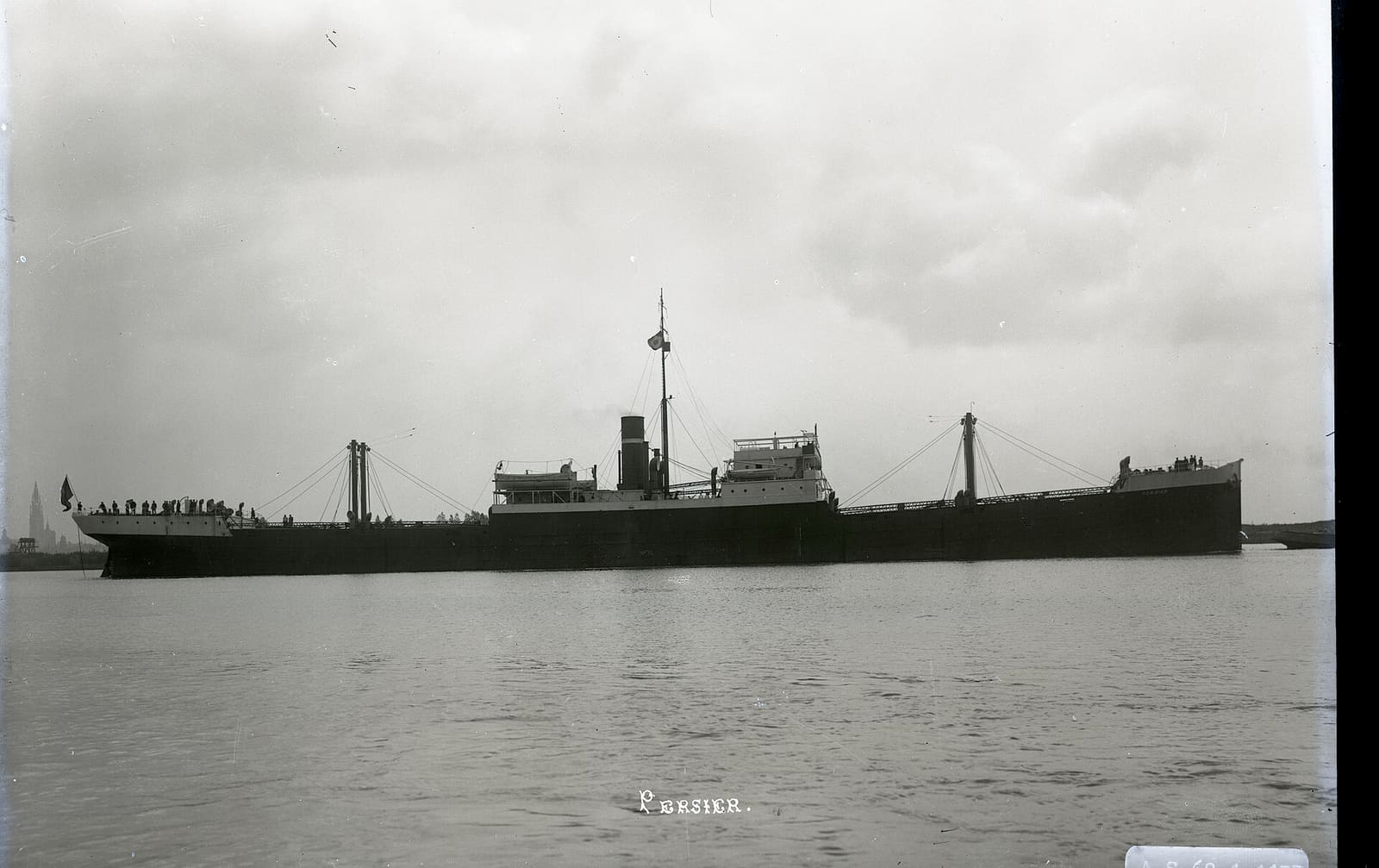
Think about what was in her holds the day she went down. Not steel, not ammunition. Soup. Dried eggs. Meat. Two thousand four hundred tons of soup alone, bound for a liberated and starving Belgium in February 1945.
She never got there. A torpedo from U-1017 caught her four nautical miles off the Eddystone Lighthouse, and she now lies on her port side in 28 m of water off the South Devon coast.
That is why the Persier is worth a trip. She is a big ship with a strange, stubborn life behind her, and she is close enough to Plymouth that you can be back in time for lunch.
A ship with four lives
She was born on the Tyne, yard number 248 at Northumberland Shipbuilding, completed in June 1918 as War Buffalo for the British Shipping Controller. Just over 400 feet long, 5,382 GRT, a triple expansion steam engine good for 10.5 knots.
In 1919 the Belgians bought her. Lloyd Royal Belge of Antwerp renamed her Persier, the second ship in the fleet to carry the name. From 1934 she even held a passenger certificate.
She was a rescuer too. In January 1922 she pulled five crew off the foundering Newfoundland schooner Eileen Lake in the Atlantic.
Then the war came and she worked hard. Operation Dynamo in May 1940. Convoy HX 84 out of Halifax that October with steel for Hull. An air raid at Oban in December 1940 where two bombs fell astern of her and the Dutch ship Breda was sunk. Nobody realised at the time that the near misses had quietly opened her seams.
Broken on an Icelandic beach
The leaks showed up on her next Atlantic crossing. More damage appeared once she was loaded at Baltimore, and the repairs left her straggling behind her convoy. Then, on 28 February 1941, a storm took her apart: hatch cover ripped off, steering gone, electrics gone. She stranded east of Vik in Myrdalur, Iceland.
What followed is almost comic in its persistence. Refloated in April, towed to Reykjavík by the tug Aegir. Taken to the Kleppsvik Strand in June, where she broke her back because she was not properly supported, and had to be beached. Refloated and re-beached in February 1942. Refloated again in May. Towed across to a Tyneside yard by the tugs Empire Bascobel and Empire Larch.
Two years out of action. Repairs finished in February 1943, and she went straight back to work with Convoy ON 169 from Liverpool to New York.
In 1944 she was picked as a blockship for Operation Overlord, prepared for scuttling, and then reprieved. They refitted her instead and sent her back to sea. Read the full chain of events on her Wikipedia page) and it starts to feel like the ship simply refused to be finished off.
11 February 1945
She left Cardiff on 8 February with Convoy BTC 65, carrying the convoy Commodore and a cargo list that reads like a relief manifest: 2,400 tons of soup, 1,400 tons of dried eggs, 1,000 tons of meat and 20 tons of general cargo.
Three days later, U-1017 fired three torpedoes and one hit. The Persier listed to port and went down by the bows. One lifeboat was swamped; another was driven into the propeller, which was still turning.
Twenty people died out of 51 crew, eight naval personnel and four stowaways. The coasters Birker Force and Gem picked up seven and 20 survivors, and HMS Cornelian took 16 more. The Persier was taken in tow, but she sank anyway.
What is down there now
Plymouth Sound BSAC found her in 1969. She lies on her port side, the seabed at 92 feet, 28 m, and the bow rising to 59 feet, 18 m. That is a useful thing to know before you drop: the ship climbs as you move forward.
She is a working reef these days. Conger eels in the plating, lobsters tucked into the shadows. On a big steamer lying hard over, every former deck becomes a wall and every doorway sits sideways, which is half the fun of swimming her.
The position is 50°17′00″N 3°58′15″W, in open water south of the Devon coast and within sight of the Eddystone on a clear day.
When to go
The English Channel here runs cold in winter and merely cool in late summer. August is the warm end at around 19°C, with the flattest water in July. The numbers below come from Open-Meteo marine data for the site.
| Month | Sea temperature (°C) | Wave height (m) |
|---|---|---|
| January | 10 | 2.5 |
| February | 10 | 2.2 |
| March | 11 | 1.4 |
| April | 11 | 1.5 |
| May | 14 | 0.8 |
| June | 15 | 1.2 |
| July | 19 | 0.6 |
| August | 19 | 0.9 |
| September | 17 | 1.0 |
| October | 15 | 1.5 |
| November | 14 | 1.8 |
| December | 12 | 2.3 |
Summer is the obvious window. Wave heights drop under a metre in May, July and August, then build steadily through the autumn until January tops out at 2.5 m. Note the anniversary of her loss falls in February, when the sea over her is at its coldest and roughest.
Dived her? Log the Persier in Scubaspot, note the depth you hit at the bow against the 28 m seabed, and post your conger shot so the next diver knows where he lives. If you are still planning, pin her and share the plan with your buddy at scubaspot.co.