Tubbataha Reef: Ten Hours Out Into the Sulu Sea
There is no resort. No beach bar, no shore entry, no shop on the corner selling O-rings. Tubbataha sits in the middle of the Sulu Sea, roughly ten hours by boat from Puerto Princesa, and the only way to dive it is to live on the boat that brought you.
That isolation is exactly the point. Because nobody lives out here, and because armed rangers have been watching the place around the clock for decades, the reef still looks like a reef is supposed to look.
Coral covers more than two-thirds of the park. The signature feature is a perpendicular wall that drops 100 metres straight down from the shallow reef top. Visibility during the season runs 30 to 45 metres. If you have been diving long enough to be tired of hearing places called pristine, this is the one that earns it.
What is actually out there
The park covers 97,030 hectares and is made up of three pieces: the North Atoll, the South Atoll, and the smaller Jessie Beazley Reef about 20 kilometres north of the two atolls. The whole thing sits 150 kilometres southeast of Puerto Princesa, the capital of Palawan.
The name comes from two Sama-Bajau words, tubba and taha, meaning a long reef exposed at low tide. Sama-Bajau people visited the reef for generations, and fishers from Cagayancillo, 130 kilometres to the northeast, called it Gusong.
The islets themselves have no fresh water, which is why nobody ever settled them. Today the only residents are 10 to 12 rotating rangers stationed at the southern tip of the North Atoll, posted two months at a time, drawn from the Philippine Navy, the Coast Guard, the municipality of Cagayancillo and the Tubbataha Management Office.
The season is short
Trips run from mid-March to mid-June. That is the window when the waves are calmest and the skies are clear, and it is the only window liveaboards work. Boats get booked years ahead, particularly around Easter and the Asian Golden Week holidays.
The usual guidance is to aim for the middle or end of April, since the calm stretch from April to June is brief. The numbers below back that up: wave heights bottom out at 0.4 metres in April and June, and the water sits around 30 degrees.
| Month | Sea temperature (°C) | Wave height (m) |
|---|---|---|
| January | 29 | 1.2 |
| February | 28 | 1.3 |
| March | 28 | 1.0 |
| April | 30 | 0.4 |
| May | 31 | 0.5 |
| June | 31 | 0.4 |
| July | 30 | 0.7 |
| August | 30 | 1.0 |
| September | 30 | 0.8 |
| October | 30 | 0.6 |
| November | 29 | 1.1 |
| December | 29 | 0.9 |
Warm water year round, then. What changes is the sea state, and that is what decides whether anyone can get out there at all.
The marine life
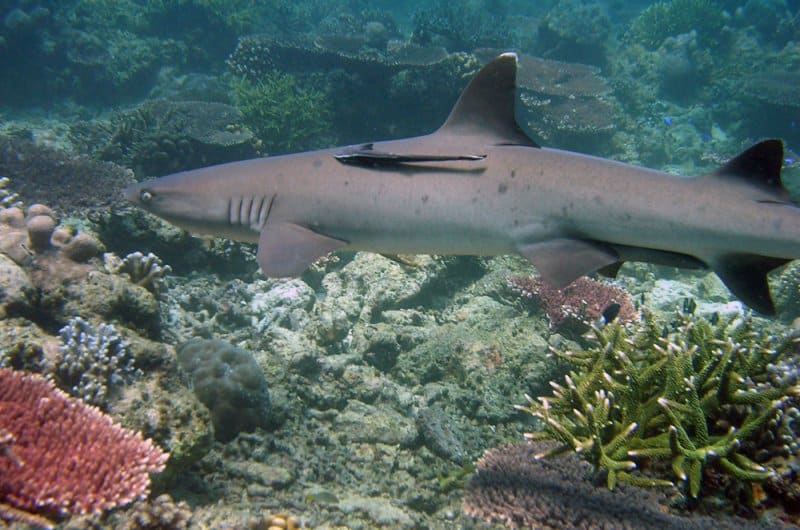
Scientists have been counting here since the 1980s and the tally stands at no fewer than 600 fish species, 360 coral species, 11 shark species, 13 dolphin and whale species and 100 bird species. Over a thousand species of marine life in total. The park is part of the Coral Triangle, which holds 75 percent of the world's described coral species and 40 percent of its reef fish.
What you will actually be looking at, out on those walls, tends to be the big stuff and the schooling stuff.
- Giant trevally and barracuda in numbers
- Manta rays and hammerhead sharks
- Napoleon wrasse, parrotfish and moray eels
- Palm-sized Moorish idols along the reef top
- Whale sharks and tiger sharks, reported but not promised
- Hawksbill and green turtles, which nest on the islets
The North Islet doubles as a nesting site for seabirds and turtles. Everything living in the park is protected. The sand bars are off limits to people entirely, though visitors can step ashore at the Ranger Station, tour it and buy souvenirs.
Protection, and the ships that got it wrong
Tubbataha became the Philippines' first national marine park in August 1988, after divers and conservationists campaigned for it. UNESCO listed it as a World Heritage Site in December 1993. Ramsar added it as a wetland of international importance in 1999, and in 2006 the park tripled in size to include Jessie Beazley Reef.
It was named the 35th ASEAN Heritage Park in November 2015, and in July 2017 the International Maritime Organization designated it a Particularly Sensitive Sea Area and an area to be avoided. The reason for that last one is a long list of groundings, including the Greenpeace ship Rainbow Warrior in 2005 and the US Navy minesweeper USS Guardian in January 2013, which had to be dismantled where she lay.
Look at a 2010-series Philippine one thousand peso note and you will find the reef on the back. That tells you something about how the country feels about this place. The full record of the park and its groundings is worth a read before you go.
Planning it
Everything leaves from Puerto Princesa. Every trip is vessel-based, because there is nowhere to sleep in the park. Budget around ten hours of steaming each way and understand that your itinerary belongs to the boat.
As of March 2011 the park entrance fee was US$75, or PHP 3,000, per person. Residents of Palawan province have been exempt from the conservation fee since September 2010.
When you get back on the boat, log the wall while the depth is still on your computer, and rate the North and South Atolls separately in Scubaspot. Add the hammerhead shot you are hoping for, or the turtle you got instead, and tag the buddy who talked you into the crossing. Start your Tubbataha log here.