USS Tarpon: the sub that sank a German raider off Japan
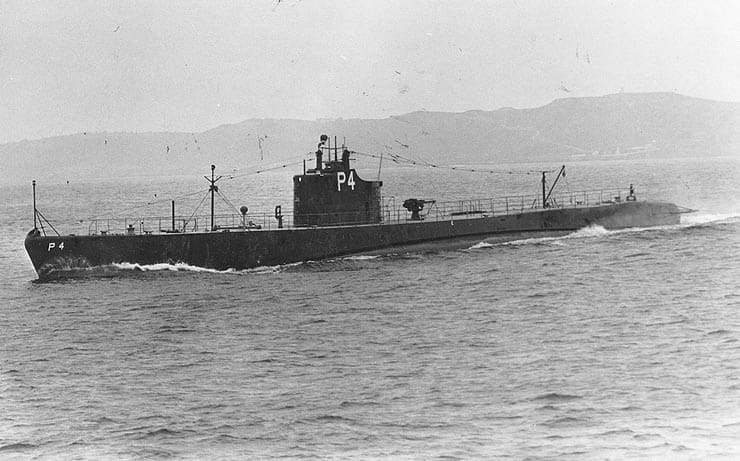
Exactly one German raider was sunk by a United States submarine in the Pacific. The boat that did it was USS Tarpon, a Porpoise-class diesel-electric submarine, and it took her eight torpedoes and most of a night to finish the job.
That alone would make her worth knowing about. What makes her a dive is the ending: she never went down in combat. She foundered in deep water south of Cape Hatteras, North Carolina, on 26 August 1957, while under tow to the scrap yard.
Her wreck sits at 34°45.195′N 75°46.025′W, off a stretch of coast that divers already cross for other steel. If you dive the Hatteras wrecks, you are diving within reach of a submarine with seven battle stars.
A boat built at Groton
Tarpon was laid down at Groton, Connecticut, by Electric Boat on 22 December 1933 and launched on 4 September 1935. Her sponsor was Eleanore Katherine Roosevelt, daughter of the Assistant Secretary of the Navy. She was commissioned on 12 March 1936.
Before the war she worked out of San Diego and Pearl Harbor, then moved west. In October 1939 her division transferred to the Philippines. By October 1941 the Asiatic Fleet had 29 submarines at Manila, and Tarpon was one of them.
Twelve war patrols
Two days after Pearl Harbor, 18 submarines left the Philippines on their first war patrols. Tarpon drew an area off southeastern Luzon and came home to Darwin on 11 January 1942 without firing a single torpedo. Nothing she positively identified ever gave her a decent angle.
Her second patrol is the one her crew would have told stories about. On the night of 23–24 February 1942 she ran aground trying to navigate Boling Strait, west of Flores Island. Ammunition, fresh water, fuel and torpedoes went over the side. She still would not float.
A native boat carried an officer ashore on Adonara and came back with a Dutch missionary, Pastor H. von Den Rulst. He told the captain the next high tide would come between 16:00 and 18:00, and mentioned that Japanese planes had been over the island four days running. With three engines backing, she slid off at flood tide.
Then came 1943 and a new captain, Tom Wogan. On 1 February, about 27 miles south of Mikura-jima, Tarpon broke the 10,935-ton passenger-cargo ship Fushimi Maru in two. A week later, on the sea lanes to Truk, four torpedoes all hit a big unidentified target: the 16,975-ton transport Tatsuta Maru, carrying soldiers. She had to go deep and never saw her sink.
The night of the Michel
On 16 October 1943 Tarpon was working the approaches to Yokohama when she picked up what she took for a large auxiliary. She tracked it until 01:56, then fired four torpedoes and stopped it dead in the water.
It got underway again and came straight at her. She submerged, passed underneath, and attacked from the far side with three more torpedoes, hitting the stern. Still afloat. One more torpedo into the same spot, and the ship exploded and disappeared.
Postwar records named the target: the German raider Michel, Schiff 28, which had been hunting Allied shipping in the Atlantic and the Pacific. No other US submarine sank a German raider in the Pacific. The full patrol record) runs to twelve patrols, including lifeguard duty off Truk and a deck-gun duel with a convoy escort in July 1944.
How she was lost
Tarpon left Pearl Harbor on Christmas Eve 1944 and reached New London on 17 January 1945. She was decommissioned at Boston on 15 November 1945, then towed to New Orleans in the spring of 1947 to serve as a Naval Reserve training boat in the 8th Naval District.
She was stricken from the Navy list on 5 September 1956. Less than a year later the tow to the breakers failed and she went down off Cape Hatteras, which is how a submarine that survived depth charges in Japanese home waters ended up as a wreck on the American coast.
Divers have been on her before. A 1991 episode of the PBS series Return to the Sea, "Secrets of the Shark," built a segment around a dive on Tarpon.
Water off Cape Hatteras through the year
The numbers below come from marine modelling for 2026 at the wreck position. The pattern is the familiar Atlantic one: coolest water in February, warmest in August, and the biggest average wave heights in October and February.
| Month | Sea temperature (°C) | Wave height (m) |
|---|---|---|
| January | 20 | 1.9 |
| February | 18 | 2.3 |
| March | 20 | 1.9 |
| April | 22 | 1.8 |
| May | 24 | 1.5 |
| June | 26 | 1.6 |
| July | 28 | 1.4 |
| August | 29 | 1.2 |
| September | 28 | 1.6 |
| October | 25 | 2.7 |
| November | 23 | 1.7 |
| December | 22 | 2.1 |
August is the calmest month in the table and the warmest. If you are building a Hatteras trip around late summer, Tarpon is a name worth adding to the list you hand the captain.
If you get out to her, log the dive in Scubaspot with the position and the depth you actually saw, and add a photo of the conning tower if the visibility gives you one. Rate the site, and tag the buddy who has been promising to come to Hatteras with you since last season.