Wakulla Springs: Mastodon Bones and the Longest Underwater Cave in the US
Destinations5 min read
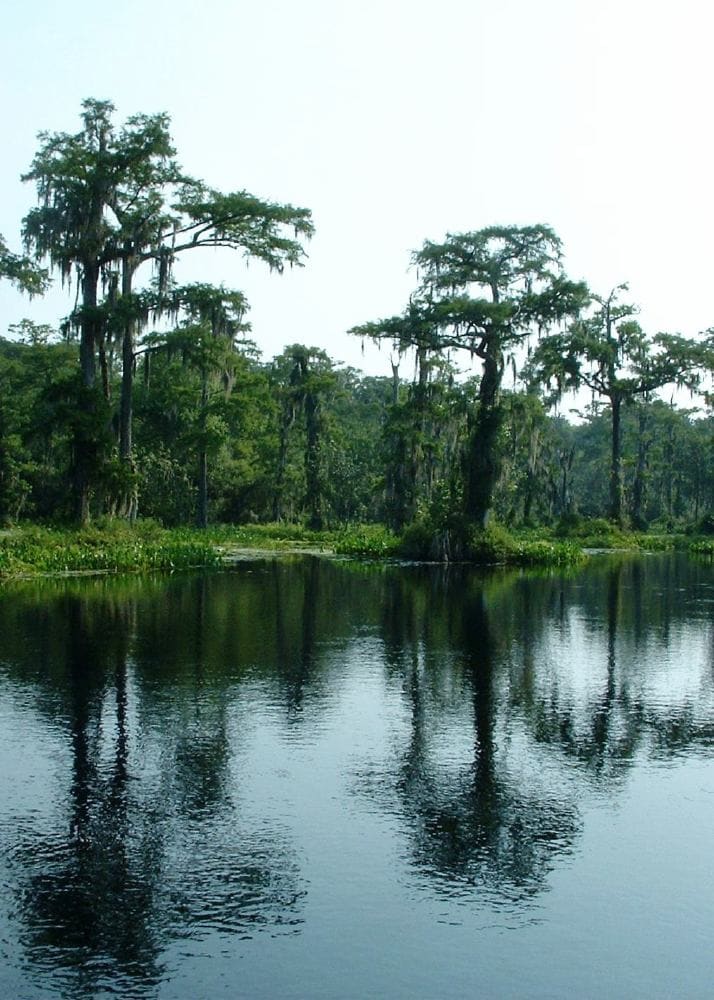
Somewhere under north Florida, water that fell as rain across 1,300 miles of basin collects in limestone and comes roaring back into daylight at Wakulla Springs. Two to three hundred million US gallons of it a day.
On the bottom of that vent, at about 190 feet, lie the fossilized remains of mastodons. In full view. Not in a museum case, not behind glass, just sitting there where they have been since the last glacial period.
And below the basin runs the longest underwater cave in the United States. That is the short version of why Wakulla matters.
A spring, a river, a cave system
Wakulla is a first magnitude spring and a major exposure point for the Floridan Aquifer. It sits 14 miles (23 km) south of Tallahassee and 5 miles (8 km) east of Crawfordville, at the crossroads of State Road 61 and State Road 267, inside the 4,490-acre Edward Ball Wakulla Springs State Park.
From the vent, the Wakulla River runs 9 miles southeast to the St. Marks, which after another 5 miles empties into the Gulf of Mexico at Apalachee Bay.
Underground it gets stranger. Wakulla Cave is a branching, flow-dominated system in the limestone of the Woodville Karst Plain: long tubes of fairly consistent diameter, holding around 300 feet (91 m) of depth, punctuated by larger chambers where passages meet. Twelve miles of it have been surveyed and mapped.
The main conduit trends south from the entrance for over 3.8 miles. Four secondary conduits feed into it, one of them from Leon Sinks.
On December 15, 2007, Woodville Karst Plain Project divers physically connected Wakulla and Leon Sinks. The combined system came to 31.99 miles (51.48 km) of explored and surveyed passage, making it the longest underwater cave in the country and the sixth largest in the world.
The fossils and the people who went looking for them
Scientific interest began in 1850, when Sarah Smith reported seeing the bones of an ancient mastodon on the bottom. At least ten extinct mammals have been identified since, some deposited as far as 1,200 feet back into the cave.
The list reads like a Pleistocene roll call.
- American mastodon
- Columbian mammoth
- Giant ground sloth
- Saber-toothed tiger
- Ancient bison
- Short-faced bear
- Equus scotti
- Miocene dugong
The Florida Geological Survey ran its first study in August and September 1930 under geologist Herman Gunter, working with hard hat gear, a dredge and long-handled grappling tongs. The mastodon they brought up is on display at the Museum of Florida History.
Vertebrate paleontologist Stanley J. Olsen returned in 1955, 1956 and 1962 with six Florida State University divers. Deeper in the complex they found more animal fossils and archaeological traces of early humans: bone and stone tools. Paleo-Indians lived at or near the spring more than 13,000 years ago, drawn, as the megafauna were, to fresh water in an arid Florida.
Then came the cave divers. From October to December 1987, an expedition led by Dr. Bill Stone, with Sheck Exley and Wes Skiles on the team, pushed 4,160 feet (1,270 m) from the entrance. Skiles filmed it for National Geographic. Stone's Cis-Lunar Mk-1 rebreather ran a 24-hour dive on half its capacity. In 1998 and 1999, over 100 volunteers joined the Wakulla 2 Project.
Water and weather through the year
| Month | Sea temperature (°C) | Wave height (m) |
|---|---|---|
| January | 15 | 0.3 |
| February | 13 | 0.5 |
| March | 19 | 0.3 |
| April | 23 | 0.4 |
| May | 27 | 0.4 |
| June | 30 | 0.4 |
| July | 32 | 0.4 |
| August | 32 | 0.3 |
| September | 30 | 0.2 |
| October | 25 | 0.4 |
| November | 19 | 0.2 |
| December | 16 | 0.3 |
Those marine figures are for the coastal water the Wakulla River eventually reaches at Apalachee Bay, and they swing hard between a 13 °C February and a 32 °C August. The spring itself is a different animal: it is the aquifer, arriving at the surface at up to 14,324 US gallons a second, as it did in the record peak flow of April 11, 1973.
What lives here now
West Indian manatees use the spring run. So do North American river otters, American alligators, Suwannee River cooters, snapping turtles and softshell turtles.
Above the water it is a birder's river: purple gallinules, herons and egrets, bald eagles, anhingas, ospreys, common moorhens, wood ducks, black and turkey vultures. White-tailed deer come down to the banks.
Not everything has held. Florida applesnail numbers crashed in late 1998 and the limpkin, which eats them, had largely left by the fall of 1999. Conservationist Jim Stevenson has described the transition toward a "biological desert". Nitrate-rich runoff and wastewater seep into the aquifer and come out here. Tallahassee's Cascades Park, a storm water drainage point built to look like a city park, is one of the responses.
The lodge, the trails and the Tarzan years
Edward Ball bought the land around the spring in 1934 and started the Wakulla Springs Lodge in 1935, hiring Marsh and Saxelbye of Mediterranean-mansion fame. It is a 27-room hotel now, a member of Historic Hotels of America. Look up: the 5,800-square-foot painted ceiling, conserved by artisans starting in 2002, shows historic Floridian scenes.
Hollywood found the place through manager Newt Perry, who shot underwater shorts here, including one where teenagers dove down to re-enact a picnic. From 1938 the MGM Tarzan crews used Wakulla as a stand-in for Africa. Creature from the Black Lagoon, Revenge of the Creature, Night Moves, Airport '77 and Joe Panther were all filmed at the spring.
On land there are up to 9 miles of hiking trails. Glass-bottom boat tours have run since 1875, though they go out less often these days because of water clarity.
If you make it to Wakulla, log the dive in Scubaspot with the depth you actually saw the mastodon bones at, and tell the rest of us whether the water was clear enough to make out the far wall of the vent. Photos of the fossils, the manatees, even that painted lodge ceiling, all of it belongs in the feed at scubaspot.co.